Small AC Issues Now Become Expensive Breakdowns by July
That slight drop in cooling performance you noticed last month? The intermittent clicking from the outdoor unit? The water stain under the indoor unit that dried up on its own? Every one of these is a warning signal that worsens as Dubai's temperatures climb from a manageable 35°C in April to a relentless 48°C in July and August.
AC units in Dubai work harder and longer than almost anywhere else on earth. A system running 16-20 hours daily during summer doesn't gradually decline - it hits a cliff when a minor issue that was manageable at moderate temperatures becomes a complete failure under peak heat load. Here are five problems that get significantly worse if you ignore them now.
1. Dirty Filters and Coils
What Happens If You Ignore It
A clogged filter restricts airflow across the evaporator coil. In spring, when your AC runs 10-12 hours daily, a dirty filter reduces efficiency by maybe 10-15%. You barely notice. In summer, when the same unit runs 18-20 hours in 48°C ambient heat, that restricted airflow causes the evaporator coil to freeze. Ice builds up on the coil, blocking airflow completely, and the compressor overheats trying to compensate.
The cascade: dirty filter leads to frozen coil, frozen coil leads to compressor strain, compressor strain leads to compressor failure. A filter clean costs AED 100-200. A compressor replacement costs AED 3,000-6,000.
Fix It Now
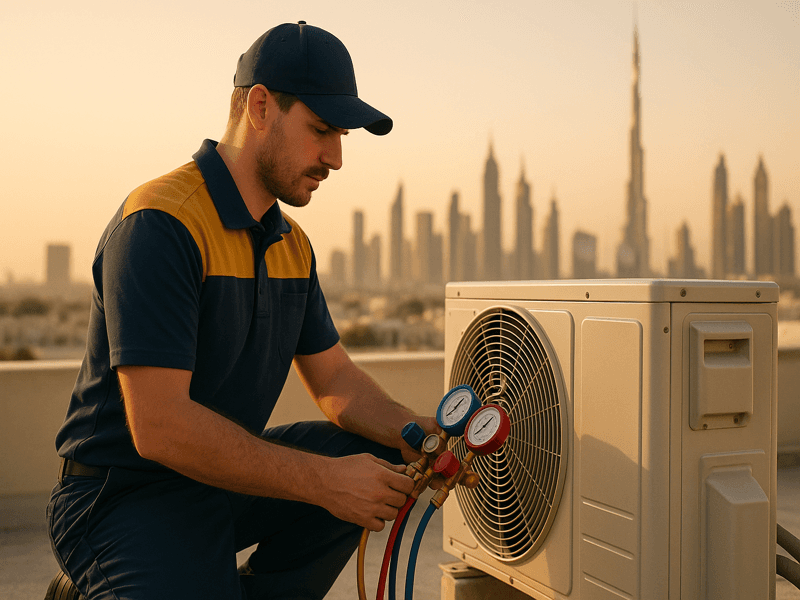
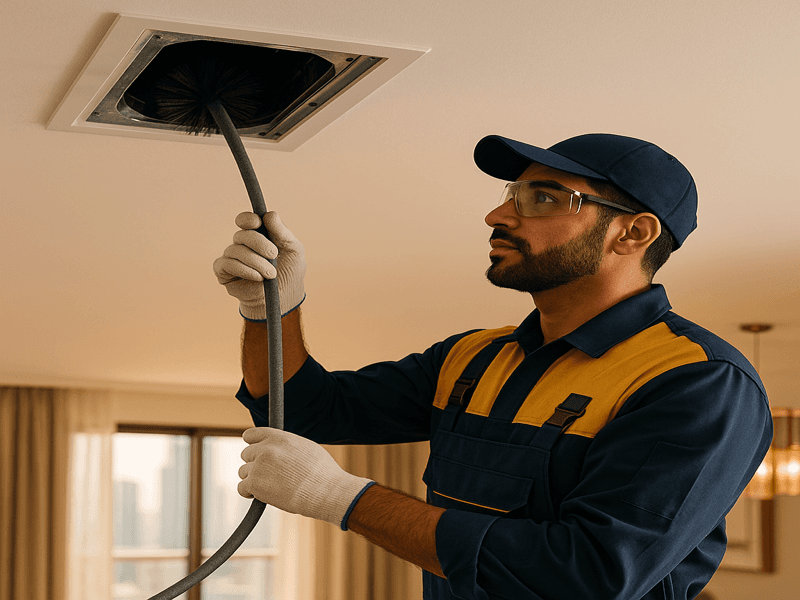
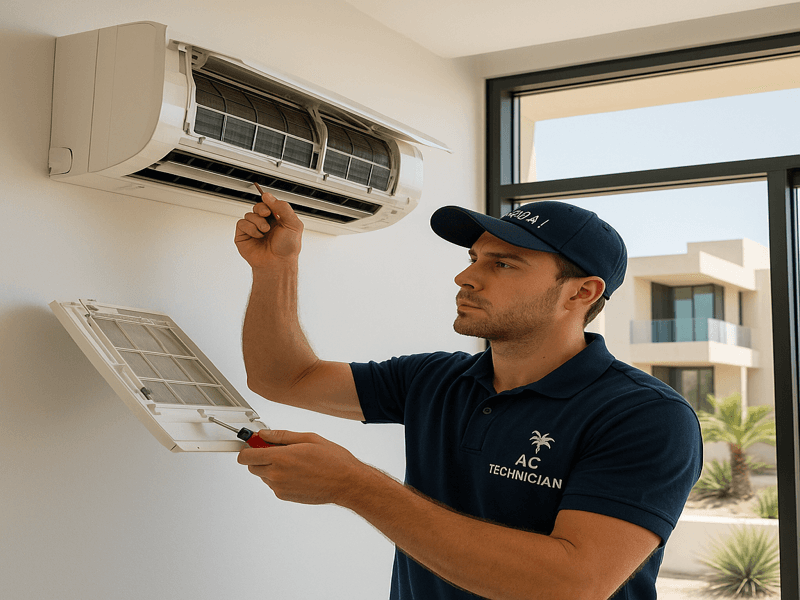
Clean or replace all AC filters before summer starts. If you haven't serviced the unit in over 6 months, book a professional deep clean that includes the evaporator coil, condenser coil, and drain system. European Technical's AC service includes filter cleaning, coil wash, drain flush, and gas pressure cheque in a single visit.
2. Low Refrigerant (Gas Level)
What Happens If You Ignore It
Refrigerant doesn't get consumed - if levels are low, there's a leak somewhere. During mild weather, a slightly undercharged system still cools adequately because the temperature differential between indoor and outdoor is smaller. The unit works a bit harder, your DEWA bill creeps up, but rooms stay comfortable.
Come summer, that mildly undercharged system can't bridge the gap between 48°C outside and 22°C inside. Rooms won't reach set temperature. The compressor runs continuously without cycling off, causing overheating and premature wear. Worse, low refrigerant means the compressor isn't cooled properly by the returning gas, which is the leading cause of compressor burnout in Dubai.
A slow leak loses roughly 5-10% of refrigerant per month. A system that was slightly low in March can be critically undercharged by June.
Fix It Now
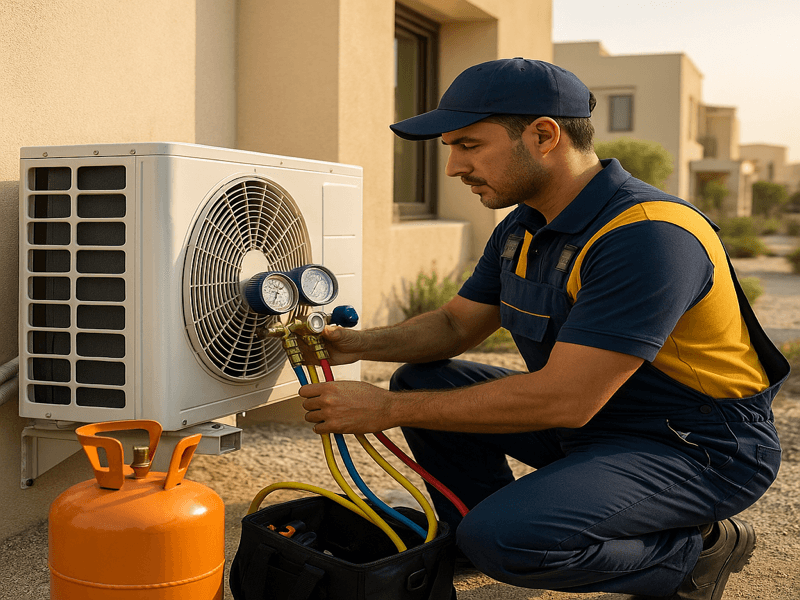
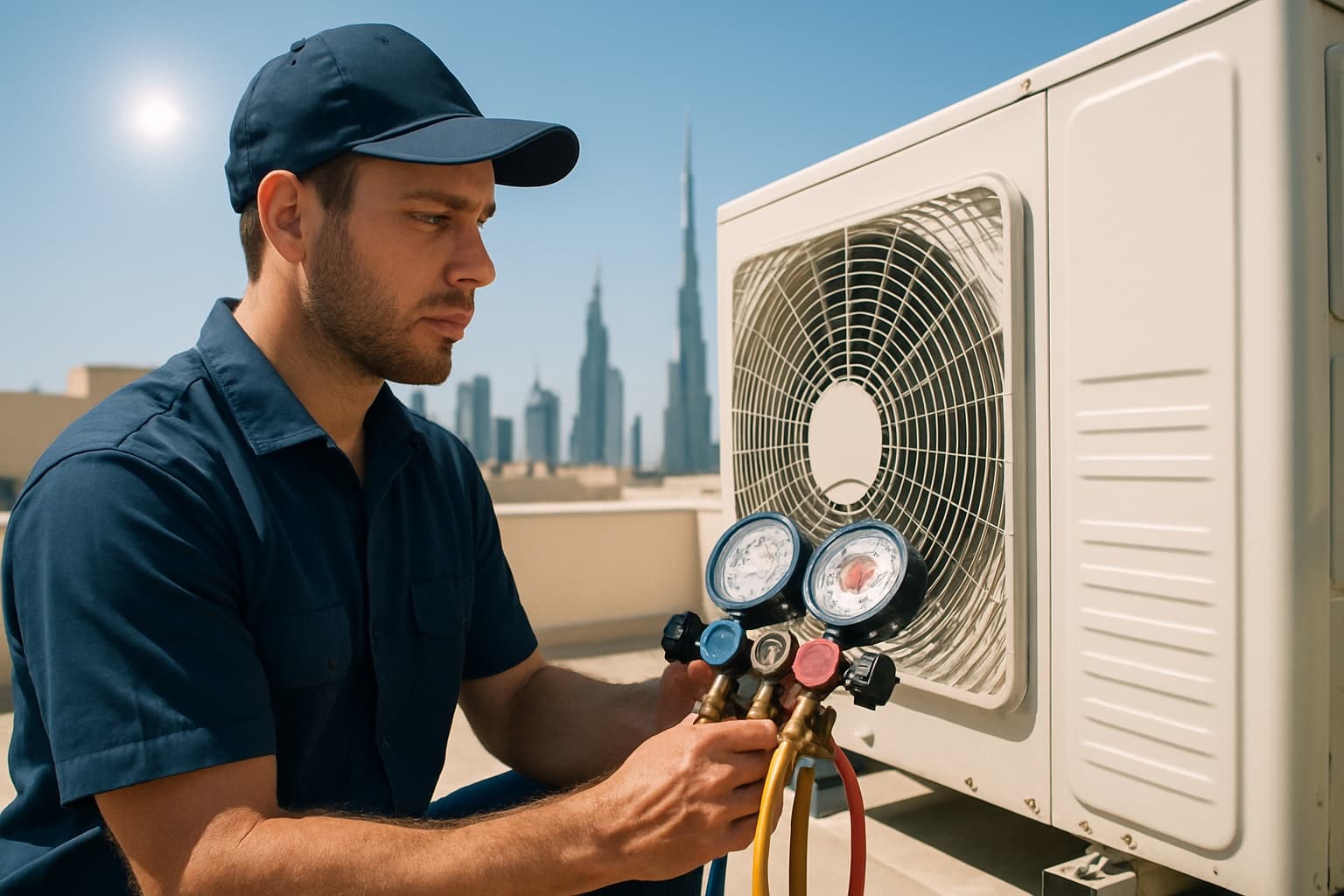
Have a technician cheque refrigerant pressure during your spring service. If levels are low, insist on finding and fixing the leak rather than just topping up the gas. Repeated top-ups without leak repair is throwing money away - at AED 150-300 per refill, it adds up fast and never solves the underlying problem.
3. Blocked Condensate Drain
What Happens If You Ignore It
Every AC unit produces condensate - water pulled from humid air during the cooling process. In Dubai's summer humidity (50-80% in coastal areas), a split unit can produce 2-5 litres of condensate per hour. This water drains through a narrow pipe that runs from the indoor unit to an external discharge point or the building's drainage system.
When this drain blocks - from algae growth, dust accumulation, or insect nesting - water backs up into the indoor unit's drain tray. The tray overflows. Water runs down your wall, stains your ceiling, damages gypsum boards, and in apartments, leaks into the unit below. In summer, condensate production doubles compared to spring. A partially blocked drain that handles spring volumes overflows within days once summer humidity kicks in.
The damage potential isn't trivial. Water damage repairs in apartments - including your neighbour's ceiling - commonly run AED 5,000 to AED 15,000.
Fix It Now
Flush all condensate drains with clean water and cheque they flow freely to the discharge point. For recurring blockages, a technician can install an inline condensate drain pump or apply anti-algae tablets that prevent biofilm buildup in the drain line. This five-minute cheque prevents thousands in water damage.
4. Faulty Thermostat or Sensor
What Happens If You Ignore It
If the room temperature sensor in your AC reads incorrectly - even by 2-3°C - the system either short-cycles (turning off before the room actually reaches temperature) or runs non-stop. In spring, either scenario is tolerable because the cooling load is moderate. The room might be slightly warm or slightly cold, and your DEWA bill absorbs the inefficiency without too much pain.
In summer, a sensor reading 2°C too warm keeps the compressor running continuously, increasing energy consumption by 20-30% and accelerating wear on every mechanical component. A sensor reading 2°C too cold stops cooling before the room reaches comfort, leaving you sweating while the AC claims it's done its job.
Sensor faults also mask other problems. If the unit's performance has degraded (low gas, dirty coils), a faulty sensor that keeps the system running non-stop compensates temporarily - until the compressor burns out.
Fix It Now
Compare the temperature displayed on your AC remote or controller with a separate room thermometer. If they differ by more than 2°C, the sensor needs recalibration or replacement - a simple fix that costs AED 100-300 and prevents months of wasted energy and accelerated wear.
5. Electrical Connection Problems
What Happens If You Ignore It
Loose electrical connections, corroded terminals, and deteriorated capacitors cause intermittent faults that worsen with heat. A loose wire that causes an occasional trip in spring becomes a daily nuisance in summer as thermal expansion widens the gap. Corroded terminals increase resistance, generating additional heat that accelerates further corrosion - a vicious cycle.
Capacitors, which help start and run the compressor motor, degrade faster in high ambient temperatures. A capacitor operating at 80% of its rated value in spring works adequately. The same capacitor at 48°C ambient drops below its functional threshold, and the compressor fails to start. You come home to a 40°C apartment.
Electrical faults also pose safety risks. Arcing at corroded connections can trip circuit breakers repeatedly, damage the AC's control board, or in rare but serious cases, cause electrical fires.
Fix It Now
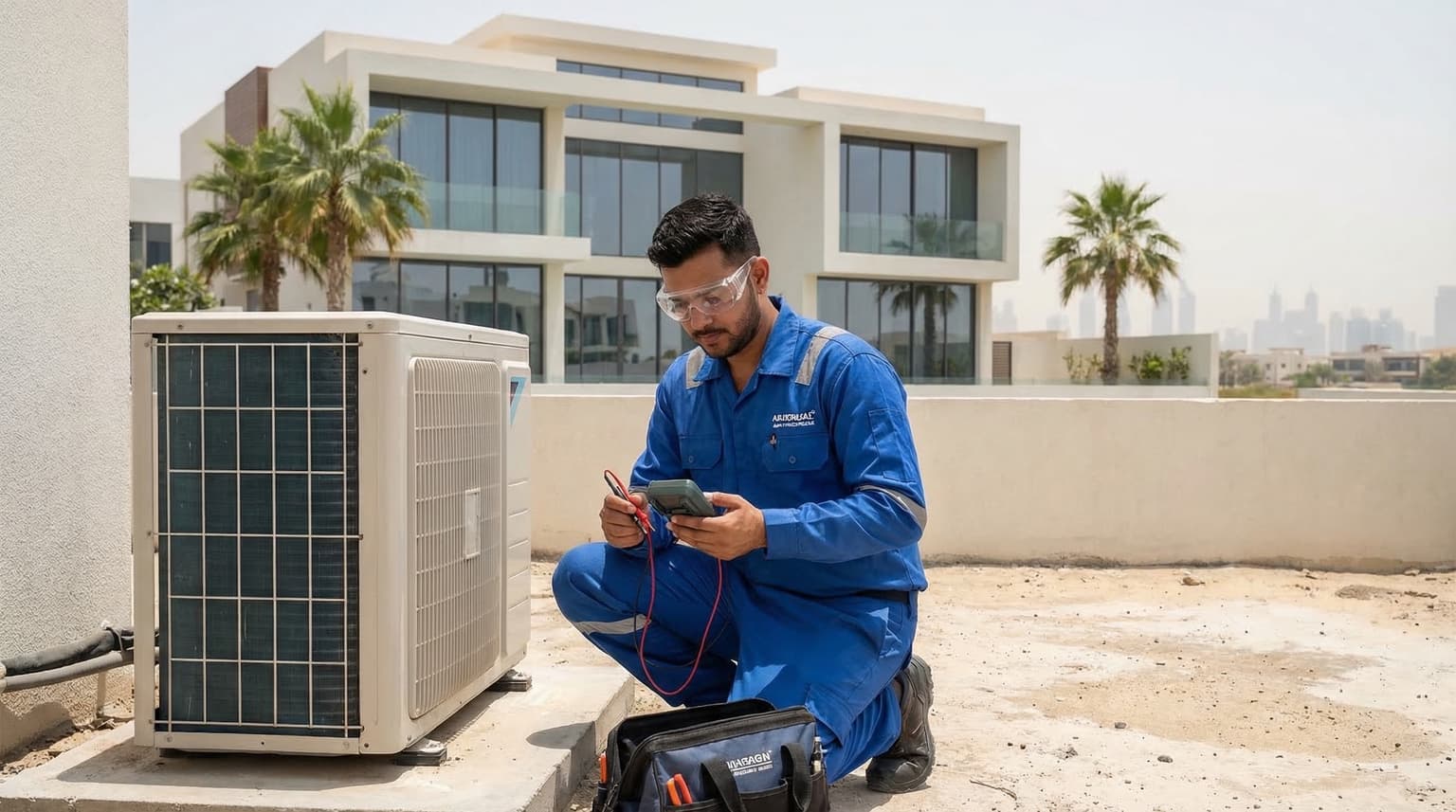
During a pre-summer service, ask the technician to cheque all electrical connections, measure capacitor values, and inspect the contactor (the relay that switches the compressor on and off). Replacing a worn capacitor costs AED 80-200. Replacing a burned-out compressor motor costs AED 2,500-5,000. The maths speaks for itself.
The Real Cost of Delaying AC Maintenance
A comparison that puts it in perspective: