Walk around any Dubai neighbourhood these days and you'll notice cameras everywhere. Bullet cameras above villa gates, domes in apartment lobbies, discreet units covering carport entrances in JVC and Mirdif. What used to be a feature of large commercial premises has become genuinely mainstream for residential properties across the city. This guide covers CCTV installation services in Dubai honestly, costs, camera types, legal requirements, and how to find an installer who actually knows what they're doing.
Why Residents Are Investing in CCTV Now
Safety isn't the only reason. Dubai already ranks among the world's safest cities, and most residents will tell you that crime isn't their main motivation.
Remote visibility is a bigger factor. Split-living arrangements are common here. Many residents spend part of the year in Europe or South Asia, or own investment properties they don't occupy. Having a camera system connected to your phone means you can cheque the property from anywhere at any time.
Insurance is increasingly a factor too. Some home insurance providers now need evidence of a functioning security system. Landlords managing short-term furnished apartments find cameras at entry points reduce disputes and protect against damage claims.
Package deliveries, housekeeper visits, and building access management round out the picture. For a city where e-commerce is relentless and property management can be complex, cameras at key points make practical sense.
Camera Types: A Straight Explanation
Lots of options exist, but most Dubai residential installations use just a few types.
Bullet Cameras
Long, cylindrical housings that mount on exterior walls. Highly visible, which is partly the point, since visibility deters. Built to handle outdoor conditions, and the better models handle Dubai's 45°C summer heat without issue.
Good for: driveways, villa perimeter walls, building entrances.
Dome Cameras
Ceiling-mounted, flush profile, no obvious pointing direction. Harder to tamper with and less intrusive visually. Wide viewing angles make them efficient for covering large indoor areas.
Good for: apartment interiors, covered parking areas, lift lobbies.
PTZ Cameras
Pan, tilt, and zoom on command, controlled remotely via software or mobile app. More expensive, but one PTZ can cover an area that would otherwise need three or four fixed cameras.
Good for: large villa grounds, commercial spaces, properties with wide perimeters.
Wireless IP Cameras
No coaxial cable required for video. Connect via Wi-Fi, which makes them attractive for rentals where running cables through walls isn't an option. Worth noting they still need power and depend on a solid Wi-Fi connection.
Good for: apartments, short-term rental properties, and situations where cabling is impractical.
Night Vision and Thermal
Night vision is standard equipment on any camera at a reasonable price point these days. For large outdoor areas, think villa perimeters in the Meadows or Arabian Ranches, thermal cameras detect heat signatures in complete darkness rather than depending on light.
Good for: large outdoor perimeters with low ambient light.
How a Professional Installation Actually Works
Screwing a mount to a wall is the easy part. Getting a system that genuinely covers your property, stores footage reliably, and lets you access it remotely takes proper planning.
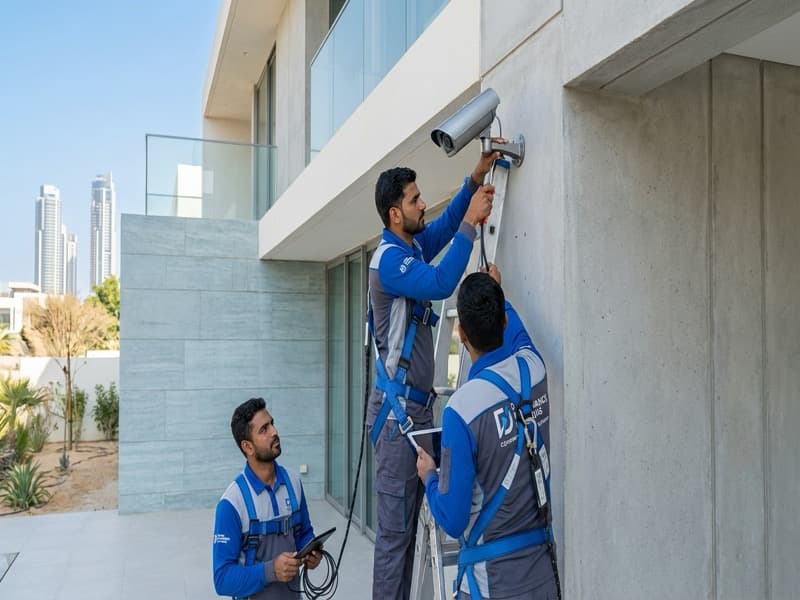
Start with a site survey. Any reputable installer visits the property before quoting. They'll walk through coverage blind spots, cable routing options, and where the recording unit will go. Good ones produce a layout diagram and agree it with you before drilling a single hole.
Cable work happens before cameras go up. For wired systems, cables are run through walls, ceiling voids, or surface conduits. Neat, hidden cabling is a mark of a professional installation. Surface-run cables that aren't properly clipped or trunked are a sign of a cut-rate job.
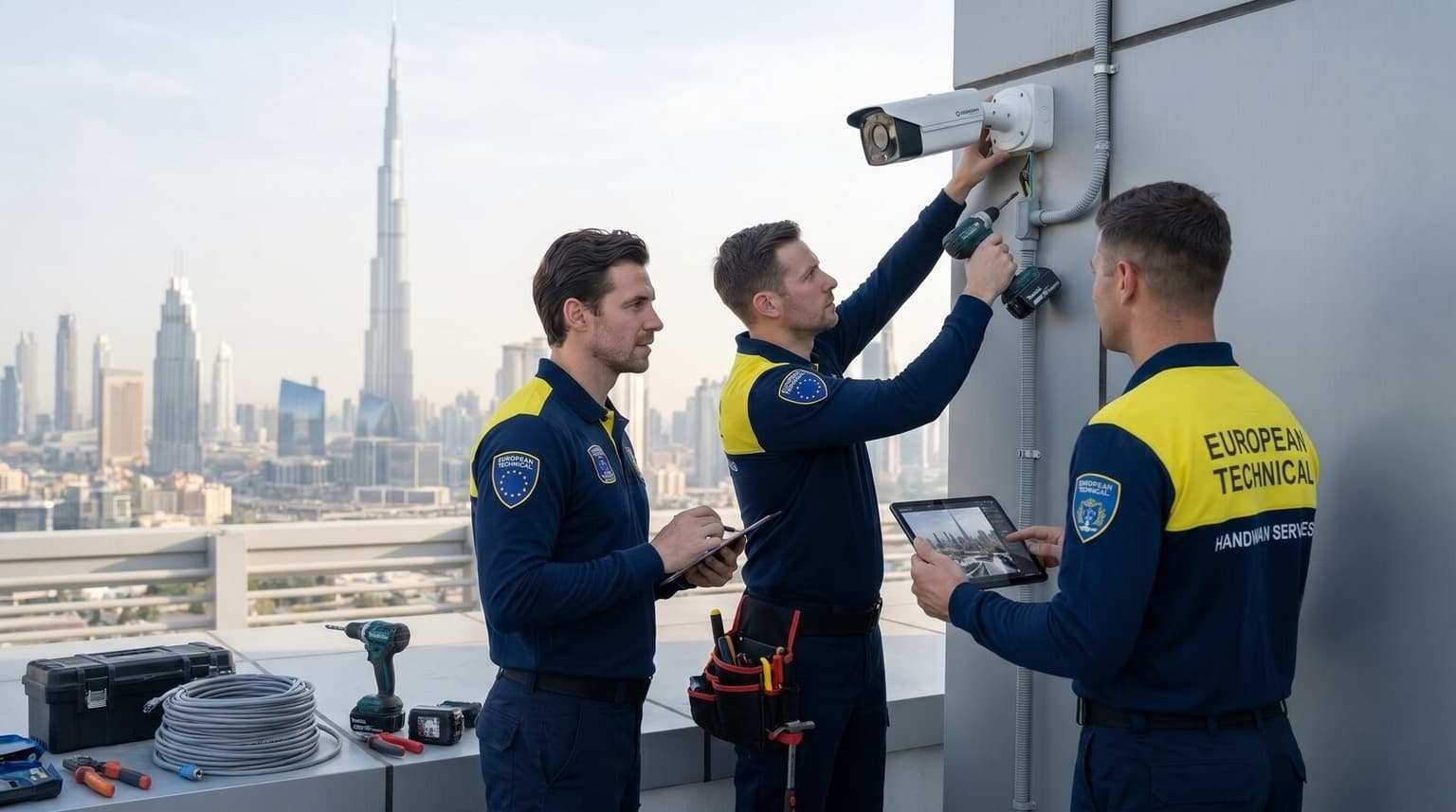
Mounting and calibration take time to do well. Cameras need to be positioned at angles that capture what matters, not just pointed in the general direction of a door. PTZ presets need programming. Field of view and focus need checking on a screen, not assumed.
DVR or NVR setup determines day-to-day usefulness. Motion detection zones, storage schedules, remote access credentials, all of this needs configuring properly. You should leave the installation knowing how to access footage and what to do if a camera goes offline.
Testing before the installer leaves is non-negotiable. Every camera checked in daylight and in night mode. Footage playback verified. Mobile app login confirmed. This is how handovers should work.
Allow four to six hours for a four-camera apartment or villa system. Larger properties with eight or more cameras may need a full day.
What CCTV Installation Costs in Dubai
A realistic guide:
Basic apartment system (2 cameras): AED 800, 1,500 Standard villa package (4 cameras): AED 1,800, 3,500 Extended villa system (8 cameras): AED 3,500, 7,000 Commercial premises: AED 5,000 and upward, depending on scope
These figures include supply, installation, and configuration. Brand matters considerably. Hikvision, Dahua, and Axis are reliable manufacturers with strong after-sales support and regular firmware updates. Budget unbranded alternatives often underperform within a year.
Running cables through reinforced concrete walls, or installing new conduit in an older building, adds to labour costs. Ask your installer to itemise this in the site survey estimate, not present it as a surprise once work is underway.
What to Ask Any Installer Before Agreeing
Not every company offering CCTV installation in Dubai is operating to the same standard. Before committing, cheque these points.
Licensing: Security system companies should hold the appropriate Dubai Police licence and any relevant trade authority registration. Ask for the licence number before signing anything.
Warranty: Minimum one year on parts and labour from the installer. Camera manufacturers supply two to three years on the hardware itself as standard.
Post-installation support: Ask directly, what happens if a camera goes offline in six months? A company without a clear answer to this question is one to avoid.
Relevant local experience: An installer who has worked in buildings similar to yours will understand the cabling challenges and building management requirements specific to Dubai. Photos of completed jobs in comparable properties are a reasonable thing to request.
Placement advice: A good installer flags any camera positions that could create issues with neighbouring properties or public areas. This isn't just courtesy, incorrect placement can have legal implications in Dubai.
Regulations: What's Permitted
Residential CCTV is legal and common across Dubai. The rules are straightforward.
Cameras must cover your own property. Capturing a neighbour's private space or filming public areas beyond your boundary can create legal exposure. Reputable installers angle cameras to avoid this as a matter of course.
Commercial properties and buildings with shared areas may need building management approval before exterior cameras go in. Most management offices have a standard process for this.
Dubai Police may request CCTV footage following an incident in or near your property. Thirty days of stored footage is the standard configuration, and most DVR and NVR units are set to this by default.
Remote Access: Practical and Increasingly Expected
Modern DVR and NVR units from Hikvision and Dahua include mobile apps that work well. Live camera feeds, recorded footage playback, motion detection notifications, and two-way audio on compatible cameras, all accessible from wherever you happen to be.
For residents who travel between Dubai and other countries regularly, this kind of remote visibility is no longer a luxury feature. Checking whether a delivery arrived, whether maintenance staff attended as scheduled, or whether a property is secure has become a routine part of managing property in Dubai.
Already have a home automation setup? Modern CCTV integrates with Apple HomeKit, Google Home, and dedicated home controllers. Visit our smart home services page for details on combined security and automation installations.
Keeping the System Running Through Dubai Summers
Outdoor cameras take real punishment during Dubai's summer months. Dust storms coat lenses and reduce image quality. UV exposure breaks down plastic housings. Heat cycling loosens mount fixings over time.
Simple maintenance prevents most problems:
- Wipe camera lenses with a soft cloth every two to three months
- cheque all mounting fixings once a year, tighten anything that's shifted
- Run a night vision test at the start of the cooler season
- Apply any DVR or NVR firmware updates when they're released
Annual maintenance checks from a technician cost AED 150, 300 and catch issues before they become camera failures.
European Technical Security Services
Our security team handles CCTV installations across Dubai for residential and commercial properties. Services include:
- Free site surveys with no obligation
- Supply and installation of Hikvision, Dahua, and other leading brands
- Integration with home automation platforms
- Ongoing maintenance and support contracts
Call +971 58 544 1160 or message on WhatsApp to arrange your free site survey. Full details are on our security systems services page, or book an appointment online.
Frequently Asked Questions
How many cameras does a standard Dubai villa need? Six to eight cameras cover most four-bedroom villas: front and rear entrances, garden perimeter, garage or carport, and one or two key interior points. The right number depends on your layout and priorities.
Do outdoor cameras hold up in Dubai's summer heat? Yes, with the right specification. Look for a minimum 60°C operating temperature and IP66 weatherproof rating on anything going outside. Both Hikvision and Dahua meet this as a baseline on their residential range.
How much footage can the system store? A 2TB drive with four cameras at standard definition holds around 30 days before footage loops and overwrites. Higher resolution or more cameras reduce that window. Additional storage drives can extend retention.
Can a tenant install CCTV in a Dubai apartment? Internal cameras need no permission in most cases. External cameras fixed to building structure need landlord agreement, ideally confirmed in writing before any drilling takes place.
NVR versus DVR, which should I choose? NVR systems use IP cameras over a network connection and deliver better image quality, easier cabling, and more capable remote access. DVR systems use older analogue cameras on coaxial cable and are found mainly in existing installations. For anything new, NVR is the right choice.
Book a Free Site Survey
Call +971 58 544 1160, message on WhatsApp, or book online. No-obligation surveys across all Dubai areas.
Author: European Technical Team