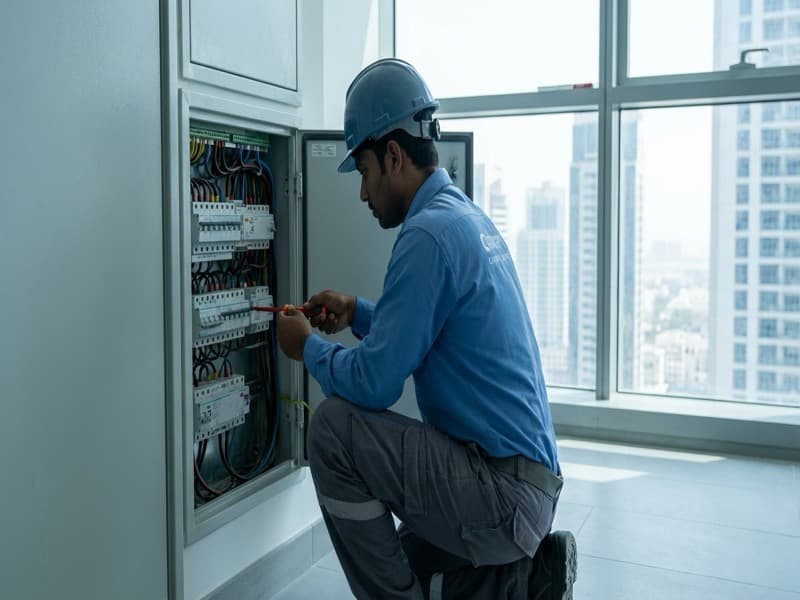
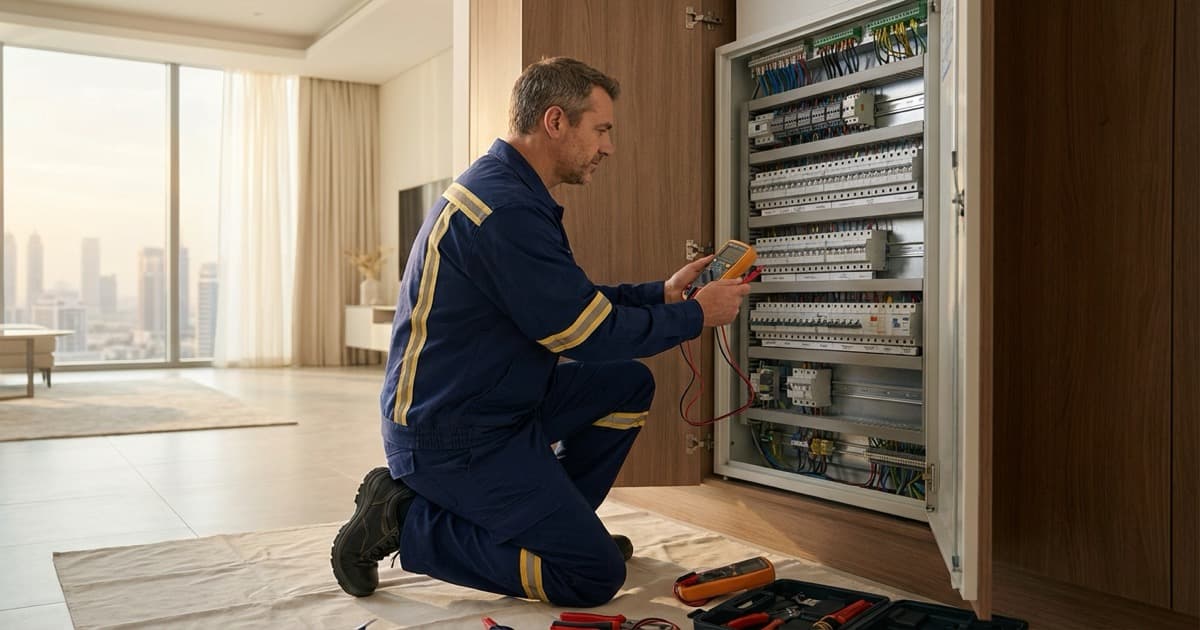
A tripped breaker at 2 AM. Lights flickering every time the AC kicks on. That faint burning smell near the kitchen outlet you've been ignoring for weeks. Electrical problems in Dubai don't send calendar invites - they show up unannounced and demand immediate attention.
Finding a trustworthy electrician in Dubai shouldn't feel like gambling with your family's safety. Yet the market is packed with unlicensed operators quoting low prices, cutting corners, and leaving behind wiring that's one summer heat wave away from a serious incident. Between DEWA regulations, the brutal climate hammering your electrical infrastructure, and the wildly inconsistent pricing across the city, most residents have no idea what a fair deal even looks like.
This guide fixes that. We're covering the full spectrum of electrical repair in Dubai - from diagnosing common faults to understanding exactly what you should pay, which repairs need permits, and how to tell a qualified electrician from someone who just owns a multimeter.
Why Electrical Problems in Dubai Are Different
Dubai's electrical systems face pressures that properties in milder climates never deal with. Understanding these factors explains why certain problems keep recurring and why quick-fix solutions rarely last.
The Heat Factor
Summer temperatures regularly push past 48°C, and rooftop surfaces can exceed 70°C. That heat doesn't just make you uncomfortable - it degrades electrical components in measurable ways:
- Cable insulation breakdown. PVC insulation rated for normal conditions softens and deteriorates faster when ambient temperatures inside wall cavities reach 50-60°C. Wiring in exterior walls and rooftop junction boxes ages roughly twice as fast as identical wiring in temperate climates.
- Contact resistance increases. Heat causes metal components in switches, outlets, and breaker terminals to expand and contract repeatedly. Over years, this thermal cycling loosens connections, increases resistance, and creates hot spots that compound the problem.
- Capacitor failure in appliances. The starting capacitors in AC compressors, water pumps, and refrigerators fail at significantly higher rates during peak summer. Each failure sends a surge through your circuits that stresses your distribution board.
Load Density
A typical Dubai apartment runs electrical loads that would strain the panels in many Western homes. Consider what's drawing power simultaneously during a July afternoon:
- 2-3 air conditioning units running at maximum capacity
- Water heater (because even "cold" water runs at 40°C+ from rooftop tanks)
- Washing machine and dryer
- Full kitchen appliances
- Entertainment systems, routers, and charging stations
Many older apartments in areas like International City, Discovery Gardens, and parts of Deira were designed for lower electrical loads than residents now demand. The original 40-amp panels in some of these buildings simply weren't built for 2026 living.
Construction Quality Variance
Dubai's building stock spans ultramodern towers with sophisticated electrical systems and older properties where shortcuts were taken during construction booms. Villas built between 2002 and 2008 - the peak of rapid construction - frequently reveal substandard wiring during renovations. Common discoveries include undersized cables on high-load circuits, junction boxes buried behind plaster with no access panel, and aluminium wiring connected to copper fittings without proper anti-oxidant compound.
None of this means your home is unsafe. But it does mean that electrical repair in Dubai requires more diagnostic skill than swapping a switch.
Common Electrical Problems in Dubai Residences
These are the issues that account for roughly 80% of residential electrical service calls across the city. Knowing what you're dealing with before calling an electrician helps you evaluate the quote you receive and avoid overpaying.
Circuit Breaker Tripping
The single most common complaint from Dubai homeowners. Your MCB (Miniature Circuit Breaker) or RCCB (Residual Current Circuit Breaker) trips, cutting power to part or all of your home.
Common causes: - Overloaded circuits. Running too many high-draw appliances on one circuit. Particularly common in kitchens and bedrooms with portable AC units.
- Short circuits. A hot wire touching a neutral wire, often caused by damaged cable insulation, pest damage, or faulty appliance wiring.
- Ground faults. Especially frequent in bathrooms and outdoor areas where moisture is present.
- Faulty breakers. MCBs themselves wear out - typically after 10,000-20,000 operations. In Dubai's high-cycling environment, that lifespan shortens.
What a proper repair looks like: A qualified electrician won't just reset the breaker. They'll use an insulation resistance tester and clamp metre to identify whether the fault is in the wiring, an appliance, or the breaker itself. If it's an overload issue, the solution might involve load balancing (redistributing circuits) rather than simply upgrading to a higher-rated breaker - which can mask a genuine wiring problem and create a fire risk.
Expected cost: AED 150-350 for diagnosis and simple fix. AED 300-750 if the breaker needs replacement. Faulty Power Outlets and Switches
Burnt, cracked, or loose outlets rank as the second most common electrical repair in Dubai homes. Older apartments in Bur Dubai, Karama, and Al Nahda are especially prone to outlet degradation.
Warning signs: - Blackening or discolouration around the outlet face
- Sparking when plugging or unplugging devices
- Outlet feels warm to the touch
- Plug sits loose and doesn't hold firmly
- Intermittent power loss at specific outlets
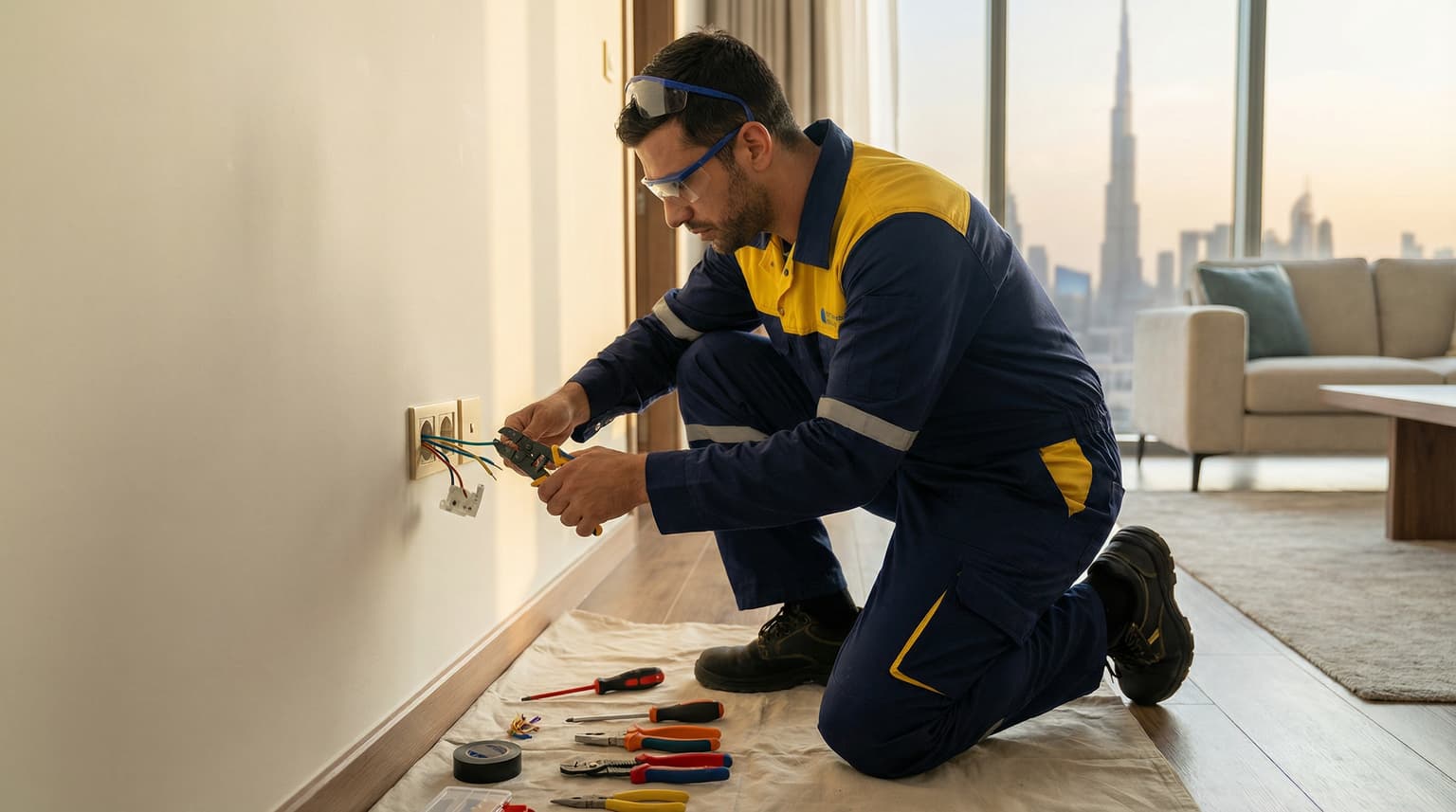
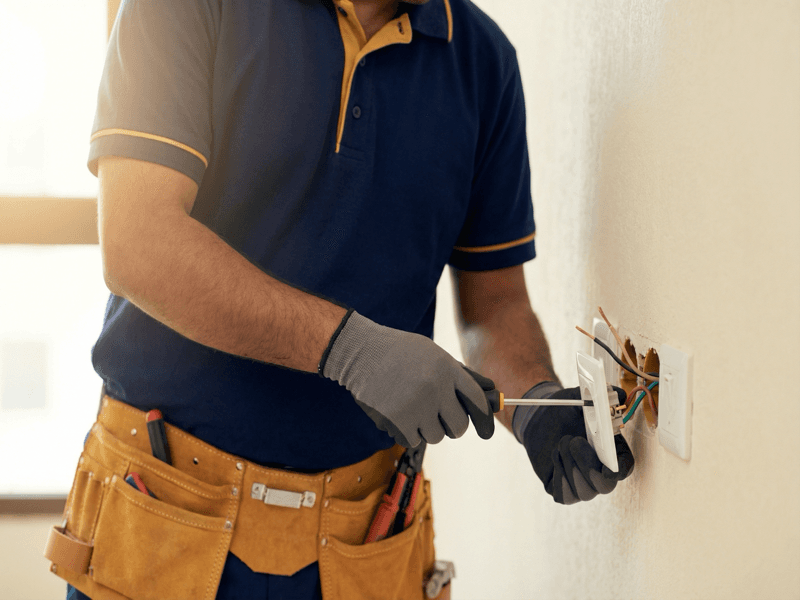
The fix: Simple outlet replacement takes 15-30 minutes per point and costs AED 100-250 including materials. But here's where experience matters: a good electrician checks the wiring behind the outlet, not just the faceplate. If the cable termination shows signs of overheating - blackened insulation, melted connectors - the repair needs to go deeper. Replacing the outlet without addressing damaged wiring behind it means the problem returns within months.
Expected cost: AED 100-250 per outlet (simple replacement). AED 300-600 if wiring needs attention behind the faceplate. Flickering or Dimming Lights
Occasional flicker when the AC compressor starts? Normal - that's a brief voltage dip caused by the compressor's inrush current. Persistent flickering? That signals a real problem.
Possible causes: - Loose wiring connections at the light fitting, switch, or junction box
- Overloaded circuit sharing a feeder with high-draw appliances
- Faulty dimmer switch (LED-incompatible dimmers are a very common culprit in Dubai)
- Neutral wire issue at the distribution board
- Voltage fluctuations from the utility supply (rare but does occur in some areas)
Expected cost: AED 150-400 depending on the root cause. Dimmer replacement runs AED 200-350 including a quality LED-compatible unit. Complete Power Loss
Total blackout in your apartment or villa while neighbours still have power. This typically points to your main breaker tripping, a fault in your metre-to-board cabling, or a problem at the building's distribution point.
Step-by-step before calling an electrician: - cheque whether the issue is building-wide (ask a neighbour or call building management)
- cheque your DEWA prepaid metre balance - exhausted credit causes disconnection
- Try resetting your main breaker (switch fully OFF, wait 30 seconds, switch ON)
- If the main breaker trips again immediately, don't try a third time - call a professional
Expected cost: AED 200-500 for diagnosis and repair. If the issue lies with the DEWA metre or building mains supply, it may be the building's responsibility rather than yours. GFCI/RCD Tripping in Wet Areas
Ground Fault Circuit Interrupters (known in the UAE as RCDs or RCCBs) protect bathrooms, kitchens, laundry rooms, and outdoor areas. When they trip repeatedly, it means current is leaking somewhere it shouldn't be.
Common triggers in Dubai: - Degraded appliance insulation - washing machines and dishwashers develop earth leakage as insulation ages in the heat
- Moisture ingress - outdoor sockets and garden lighting connections that aren't properly sealed
- Water heater element failure - one of the most common causes of RCD trips in Dubai apartments
- Bathroom extractor fan wiring - condensation reaches connections over time
Expected cost: AED 200-450 for fault diagnosis and repair. Water heater element replacement runs AED 300-600 including parts. Wiring Problems
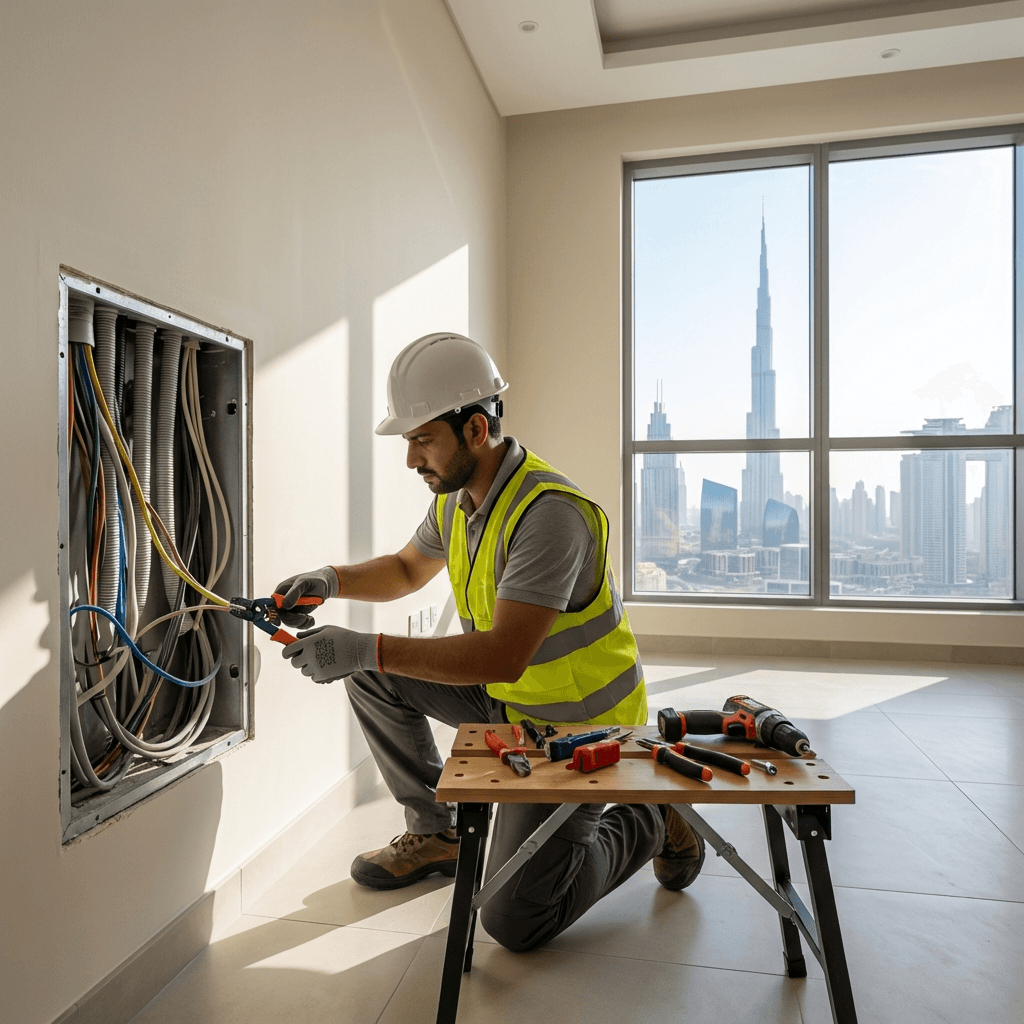
This is where electrical repair in Dubai gets more involved. Wiring issues range from a single damaged cable to a full rewire requirement.
Signs of wiring problems: - Multiple outlets or circuits failing simultaneously
- Burning smell with no identifiable source
- Breakers that trip at random intervals without a consistent pattern
- Visibly damaged or discoloured cables where visible (attic, utility cupboard)
- Aluminium wiring (silver-coloured) in a property built before 2010
Partial rewiring - replacing cables in a specific area or circuit - typically costs AED 1,500-4,000 depending on accessibility and length of run. Full apartment rewiring prices:
| Property Type | Typical Cost (AED) | Timeframe |
|---|
| Studio / 1-bed apartment | 3,000-6,000 | 2-4 days |
| 2-bed apartment | 5,000-9,000 | 3-5 days |
| 3-bed apartment | 7,000-12,000 | 4-7 days |
| 3-bed villa | 10,000-18,000 | 5-10 days |
| 5-bed villa | 18,000-35,000 | 7-14 days |
These figures include materials (cables, trunking, back boxes) but exclude finishing work like plastering and painting over cable channels. DEWA inspection fees are additional.
Electrical Repair Pricing in Dubai: What You Should Actually Pay
Pricing transparency barely exists in the Dubai electrical repair market. Quotes vary by 300% for the same job depending on who you call. A realistic breakdown based on current market rates so you can spot overcharging before it happens.
Standard Service Rates
| Service | Price Range (AED) | Notes |
|---|
| Call-out / inspection fee | 100-200 | Often waived if you proceed with repair |
| Socket / switch replacement | 100-250 per point | Includes standard Legrand or Schneider fitting |
| Light fitting installation | 150-350 per fitting | Excludes the fitting itself |
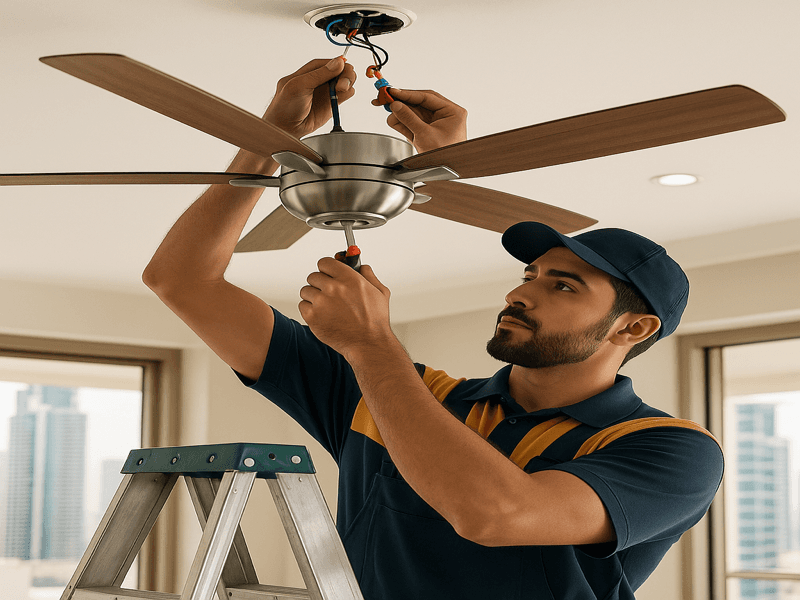
| Ceiling fan installation | 200-400 | Includes mounting bracket and wiring |
| Circuit breaker replacement | 200-450 | MCB; RCCB replacement costs more |
| Distribution board upgrade | 1,500-4,000 | Depends on number of ways and brand |
| Dedicated AC circuit | 500-1,200 | New cable run from DB to AC unit |
| Outdoor lighting installation | 300-800 per circuit | Includes weatherproof fittings |
| EV charger installation | 2,000-5,000 | Type 2, 7-22kW, excluding DEWA approval |
| Chandelier installation | 300-800 | Depends on weight and ceiling type |
| Emergency call-out (after hours) | +100-200 | Added to standard repair cost |
What Drives Price Differences
- Location within Dubai. Electricians servicing Palm Jumeirah, Emirates Hills, and Downtown often charge 20-40%, or International City. This reflects parking costs, access logistics, and the expectation of premium pricing in premium areas.
- Material quality. A Schneider Electric MCB costs AED 35-60. An unbranded equivalent costs AED 8-15. The price difference matters - cheap breakers have higher failure rates and aren't certified to UAE standards. Always ask what brand of materials will be used.
- Scope creep. A competent electrician identifies the full scope during initial inspection. Watch out for companies that quote low, start the work, then discover "additional problems" that inflate the final bill. Get the scope and price in writing before work begins.
- Licensing and insurance. licenced, insured electricians carry higher overhead than solo operators working from a van. The premium is worth it - you're paying for accountability, warranty coverage, and recourse if something goes wrong.
Red Flags in Electrical Repair Quotes
Walk away from any electrician who:
- Quotes a fixed price over the phone without inspecting the job
- Can't produce a valid Dubai trade licence when asked
- Suggests using "same quality" unbranded materials to reduce cost
- Wants cash payment with no receipt or documentation
- Proposes upgrading your breaker rating without testing the wiring first
- Claims DEWA approval "isn't needed" for work that clearly requires it
DEWA Regulations and Permits: What Dubai Residents Must Know
Dubai Electricity and Water Authority regulates all electrical installations and major modifications in the emirate. Understanding what needs a permit and what doesn't saves you from compliance headaches and potential fines.
Work That Doesn't need DEWA Approval
- Replacing like-for-like switches, sockets, and light fittings
- Replacing a faulty MCB or RCCB with the same-rated unit
- Changing light bulbs and tubes
- Resetting tripped breakers
- Minor appliance repairs
Work That Requires DEWA Approval
- Adding new circuits or power points to your distribution board
- Upgrading your main breaker or total connected load
- Installing EV charging stations
- Full or partial rewiring
- Distribution board replacement or upgrade
- Any electrical work as part of a fit-out or renovation with a Dubai Municipality permit
- Solar panel installations
- Generator connections
The Approval Process (Simplified)
- Engage a DEWA-approved electrical contractor. They submit drawings and specifications on your behalf through the DEWA online portal.
- DEWA reviews and approves the design. Turnaround varies from 3-10 working days for residential projects.
- Work is carried out according to the approved design.
- DEWA inspection. A DEWA inspector visits to verify the installation matches the approved plans and meets safety standards.
- Completion certificate issued. This document confirms your electrical work is compliant and allows load activation.
Skipping this process isn't just risky - it can create serious problems when you eventually sell or rent the property. Unapproved electrical modifications flag during buyer due diligence and building inspections, potentially killing deals or requiring costly remediation.
NOC Requirements for Apartments
If you live in an apartment, your building management must issue a No Objection Certificate before any electrical modification work begins. The NOC process typically requires:
- A scope of work document from your electrical contractor
- Proof the contractor is licenced
- Confirmation that the work won't affect building common areas or other units
- An undertaking to restore any common area access points used during the work
Most building management offices process NOCs within 3-5 working days. Some developments (particularly in DIFC, Downtown, and Dubai Marina) have stricter requirements and longer processing times.
Choosing the Right Electrician in Dubai
The difference between a good electrician and a bad one in Dubai isn't just about skill - it's about your safety, your property's value, and your. How to evaluate who you're hiring.
Non-Negotiable Qualifications
- Valid Dubai Trade Licence. Every legitimate electrical contractor operating in Dubai holds a trade licence issued by the Department of Economy and Tourism (DET). Ask to see it. Verify it online through the DET portal if you want to be thorough.
- DEWA-Approved Status. For any work requiring permits, the contractor must be registered with DEWA as an approved electrical contractor. This is separate from their trade licence and confirms they can submit designs and request inspections.
- Liability Insurance. Professional liability and workman's compensation insurance protects you if something goes wrong during or after the repair. Uninsured contractors leave you holding the bill for any damage or injury.
- Qualified Technicians. The person doing the actual work should hold relevant electrical qualifications. In the UAE, this typically means IET (Institution of Engineering and Technology) certification or equivalent. City & Guilds qualifications from the UK are common among skilled electricians in Dubai.
Questions to Ask Before Hiring
- "Can I see your Dubai trade licence?" (Immediate disqualification if they hesitate)
- "Are you DEWA-approved for permit work?" (Critical for anything beyond basic repairs)
- "What brand of materials do you use?" (Good answer: Schneider, ABB, Legrand, Hager. Bad answer: "Whatever's available")
- "Will you give a written quote with itemised costs?" (Non-negotiable)
- "Do you offer a warranty on your work?" (Industry standard is 3-12 months)
- "Can you give references from similar properties?" (Especially relevant for villa rewiring or panel upgrades)
Where to Find Reliable Electricians
- Direct from established maintenance companies. Companies like European Technical that offer full-spectrum maintenance services typically employ or retain vetted, qualified electricians. The advantage: accountability, warranties, and consistent quality standards.
- DEWA's approved contractor list. Available through the DEWA website, this list confirms which companies are authorised to carry out permit-level electrical work.
- Referrals from building management. Your building's facilities management team works with electricians regularly and can recommend contractors they've verified.
- Avoid random social media listings. Facebook Marketplace and Instagram contractors may be skilled - or may not be. Without verification, you're rolling the dice.
Electrical Safety for Dubai Properties: Prevention Over Repair
The smartest approach to electrical repair is avoiding the need for emergency fixes in the first place. These preventive measures cost a fraction of emergency repairs and protect your family.
Annual Electrical Inspection
Every Dubai property should undergo a professional electrical inspection at least once per year - twice yearly for older properties or villas. A thorough inspection includes:
- Insulation resistance testing on all circuits (confirms cables haven't degraded)
- Earth continuity testing (verifies your safety earth is functional)
- RCD trip testing (confirms your safety devices activate within specification)
- Thermal imaging of distribution board (identifies hot spots before they become faults)
- Visual inspection of accessible wiring, junction boxes, and consumer unit
Cost: AED 300-800 for an apartment. AED 500-1,500 for a villa. Worth every dirham compared to the cost of an electrical fire or equipment damage from an undetected fault. Surge Protection
Dubai's power grid is reliable, but voltage spikes still occur - particularly during thunderstorms (more common than most residents realise) and DEWA grid switching events. A whole-home surge protector installed at your distribution board costs AED 400-800 and protects every connected device.
For expensive electronics and appliances, point-of-use surge protectors (AED 50-150 per unit) add a second layer of defence. This is especially relevant for home offices with computer equipment, entertainment systems, and smart home hubs.
Load Assessment
If you're moving into a property or planning to add significant electrical loads (EV charger, home office, home gym equipment, additional AC units), have an electrician assess whether your existing panel and wiring can handle the increased demand. A load assessment costs AED 200-400 and takes about an hour.
Discovering your panel is undersized before you buy the equipment beats discovering it after the breaker trips during your first Zoom call while the AC is running.
Smart Home Electrical Considerations
Dubai's embrace of smart home technology creates new electrical requirements. Smart switches, automated lighting systems, and home automation hubs draw modest individual loads but collectively add up. More critically, they need neutral wires at switch locations - which many older Dubai properties don't have.
Before committing to a smart home retrofit, have an electrician verify that your switch boxes contain neutral wires. Retrofitting neutral wires to switch locations costs AED 200-400 per switch point. It's a fraction of the cost of discovering the problem after buying AED 5,000 worth of smart switches that won't work without them.
Area-Specific Electrical Challenges Across Dubai
Different parts of Dubai present different electrical profiles. Knowing what to expect in your neighbourhood helps you anticipate issues and communicate effectively with your electrician.
Older Apartments (Deira, Bur Dubai, Karama, Al Nahda)
Properties built in the 1990s and early 2000s with dated electrical infrastructure. Common issues: undersized distribution boards, limited circuit count, old-style fuse boxes rather than MCB panels, and degraded cable insulation. Full panel upgrades are frequently needed and represent the best investment in these properties.
Mid-Range Communities (JVC, Sports City, Silicon Oasis, Discovery Gardens)
Built during the 2005-2010 construction wave. Generally adequate wiring but panels often undersized for current usage patterns. Discovery Gardens in particular has documented electrical challenges due to the speed of its construction. Socket quality varies significantly between buildings.
Premium Towers (Dubai Marina, Downtown, Business Bay, JBR)
Newer, higher-quality electrical installations but complexity brings its own challenges. Multi-zone lighting systems, automated blinds, building management system integration, and high-capacity panels. Issues tend to involve smart system integration and load management rather than basic wiring faults.
Villas (Arabian Ranches, The Springs, Jumeirah, Mirdif, Al Barsha)
Larger properties with more extensive electrical networks. Garden lighting circuits, pool pump feeds, gate motor connections, and detached garage wiring add complexity. Villas frequently need additional circuits as families expand usage - home offices, gym equipment, EV chargers, and outdoor entertainment areas. Cable runs are longer, which means higher material costs and greater voltage drop considerations.
New Developments (Dubai Hills, Tilal Al Ghaf, Damac Hills 2, Town Square)
Modern electrical systems built to current DEWA standards. Fewer repair needs in the early years, but snag-related electrical issues are common during the first 12-18 months after handover. Developers are obligated to address genuine defects during the warranty period - document everything and submit through official channels.
Emergency Electrical Repair: What to Do When Things Go Wrong
Electrical emergencies in Dubai demand clear-headed responses. Your action plan for the most common emergency scenarios.
Burning Smell or Visible Smoke
- Kill the main breaker at your distribution board immediately
- Evacuate everyone from the affected area
- If there's visible fire, use a CO2 or dry powder extinguisher - never water on an electrical fire
- Call Civil Defence (997) if fire is present or spreading
- Call an emergency electrician once the immediate danger is resolved
Electric Shock
- Don't touch the person if they're still in contact with the electrical source
- Switch off the main breaker or use a non-conductive object (wooden chair, rubber mat) to separate them from the source
- Call 998 (ambulance) immediately
- Begin CPR if the person is unconscious and not breathing
Flooding with Electrical Exposure
Dubai experiences occasional flooding during winter rains - particularly in ground-floor apartments, villas, and basement areas.
- don't enter a flooded area if electrical outlets, appliances, or wiring are submerged
- Switch off the main breaker from a dry location if you can reach it safely
- Call DEWA on 991 to disconnect supply if needed
- Have a qualified electrician inspect and test all circuits before restoring power
Overnight Power Loss
If you lose power overnight and your breaker won't reset:
- Transfer perishable food to a neighbour's fridge or a cooler with ice
- Use battery-powered lights - avoid candles (fire risk)
- Call a 24/7 emergency electrician
- If you've medical equipment requiring power (CPAP machine, etc.), consider relocating temporarily
Emergency electrical repair call-outs in Dubai typically cost AED 300-600 depending on the time and nature of the fault. That includes diagnosis and basic repair. Complex emergency fixes are quoted after initial assessment.
Villa Versus Apartment Electrical Systems: Key Differences
Understanding whether your property type affects repair approaches and costs.
Apartment Electrical Characteristics
- Single distribution board serving all circuits (typically 12-24 ways)
- Shared earth system with the building
- Building management involvement for major work
- Limited cable access - most wiring is embedded in concrete walls
- Common area interfaces (intercom, building automation) add complexity
Villa Electrical Characteristics
- Multiple distribution boards in larger properties (main DB plus sub-boards for extensions, garages, garden)
- Independent earth rod or earth mat installation
- Full control over modifications (subject to DEWA approval)
- Accessible cable routes through ceiling voids, under floors, and along external walls
- External circuits for landscaping, pool, gate, and perimeter lighting
- Higher total connected load requiring larger main breakers and supply cables
Cost Implications
Apartment repairs are generally cheaper per-item due to shorter cable runs and simpler systems. Villa repairs cost more individually but offer greater flexibility in execution. Budget roughly 40-60% more for equivalent work in a villa compared to an apartment.
Electrical Upgrades Worth Considering in 2026
Beyond repair, several electrical upgrades deliver strong returns on investment for Dubai property owners.
USB-C Outlet Installation
Modern USB-C outlets with integrated fast charging eliminate the need for wall adapters. Cost: AED 150-300 per point installed. Particularly worthwhile in bedrooms, living rooms, and home offices. Choose outlets with at least 20W delivery for phone and tablet charging capability.
LED Lighting Conversion
If your property still has halogen downlights (common in villas and older apartments), switching to LED cuts lighting electricity consumption by 80% and significantly reduces heat output - which means your AC works less hard, compounding savings. Full conversion for a 2-bed apartment runs AED 1,500-3,000 including fittings.
Distribution Board Upgrade
Upgrading from an old fuse board or undersized MCB panel to a modern RCBO-protected distribution board costs AED 2,000-4,000 for an apartment and AED 3,000-6,000 for a villa. RCBOs combine overcurrent and earth fault protection in a single device per circuit, meaning a fault on one circuit doesn't kill power to the entire property. This is the single most impactful electrical upgrade for older Dubai properties.
EV Charger Pre-Wiring
Even if you don't drive an electric vehicle today, running the cable from your distribution board to your parking field now costs a fraction of retrofitting it later - especially in apartments where access to cable routes may need coordination with building management. Pre-wiring costs AED 800-2,000 depending on cable length.
Whole-Home Surge Protection
As mentioned in the prevention section, a Type 2 surge protection device at your distribution board (AED 400-800 installed) protects everything downstream. With the average Dubai household now containing AED 20,000-50,000 worth of connected electronics, the maths speaks for itself.
How European Technical Handles Electrical Repair in Dubai
European Technical brings a structured, European-standard approach to electrical repair across Dubai. What sets the service apart from the typical market experience.
Diagnostic-first approach. Every job starts with proper fault diagnosis using calibrated test equipment - insulation resistance testers, loop impedance testers, thermal cameras, and power quality analysers. No guesswork. No "let's try replacing this and see." Transparent quoting. After diagnosis, you receive an itemised quote breaking down labour, materials (by brand and model), and any permit costs. The price you approve is the price you pay. No surprise add-ons. Quality materials only. European Technical uses Schneider Electric, ABB, Legrand, and Hager components exclusively. These brands are engineered for harsh climate conditions and carry genuine manufacturer warranties. They cost more than unbranded alternatives - and they last years longer. DEWA compliance built in. For any work requiring permits, European Technical handles the full approval process: design submission, DEWA coordination, inspection scheduling, and completion certification. You don't need to handle DEWA's systems yourself. Warranty on all work. Every electrical repair comes with a workmanship warranty. If something European Technical installed or repaired develops a fault within the warranty period, it's fixed at no charge. Available across Dubai. From Palm Jumeirah to International City, Arabian Ranches to Dubai Marina. Same-day service for standard repairs, emergency response for urgent issues. Ready to get your electrical problems resolved properly? Call European Technical on +971 58 596 0558 or request a quote online. Diagnosis is thorough, pricing is honest, and the work is done right.
Frequently Asked Questions About Electrical Repair in Dubai
How much does electrical repair cost in Dubai?
Basic repairs like socket or switch replacement run AED 100-250 per point. Circuit breaker diagnosis and repair costs AED 150-750 depending on complexity. Full apartment rewiring ranges from AED 3,000-12,000 based on property size. Emergency call-outs add AED 100-200 to the base repair cost. Always request an itemised written quote before work begins - and be cautious of any quote that seems significantly cheaper than market rate.
Do I need DEWA approval for electrical work in my home?
For minor repairs - replacing a switch, swapping a faulty outlet, changing a breaker with an identical unit - no DEWA approval is needed. But anything involving new circuits, load increases, distribution board changes, EV charger installations, or wiring modifications requires DEWA approval through a registered electrical contractor. Your contractor handles the submission and inspection process. Skipping this step creates compliance problems when you sell, rent, or renovate the property later.
What are the most common electrical problems in Dubai homes?
Circuit breaker tripping tops the list, particularly during summer when AC loads peak. Burnt or loose power outlets are the second most frequent call, especially in buildings over 10 years old. Flickering lights (often caused by loose connections or incompatible dimmer switches), GFCI/RCD trips in wet areas, and voltage fluctuations round out the top five. Dubai's extreme heat accelerates wear on electrical components, making problems that might take decades in mild climates appear within 5-10 years here.
Is 24/7 emergency electrical repair available in Dubai?
Yes. Several established maintenance companies in Dubai offer round-the-clock emergency electrical services, including European Technical. Response times typically range from 45-90 minutes depending on your location and traffic conditions. Emergency rates apply after standard business hours (usually after 6 PM and before 8 AM, plus Fridays and public holidays), adding AED 100-200 to the standard repair cost. For genuine emergencies involving safety risks, don't wait until morning - electrical faults can escalate.
How do I know if my villa needs a full rewiring?
Key indicators include: the property is over 20 years old with original wiring, circuit breakers trip frequently without a single identifiable cause, you notice a burning smell near walls or outlets, wall plates show discolouration, your distribution board still uses old-style fuses instead of MCBs, or you're planning a major renovation that will open up walls anyway. The definitive test is an insulation resistance measurement across all circuits - if readings fall below acceptable thresholds, rewiring is the only reliable solution. A professional electrical inspection (AED 500-1,500 for a villa) provides the data you need to make an informed decision.
Can I do electrical repairs myself in Dubai?
You can replace a light bulb, reset a tripped breaker, or change a blown fuse in a plug-top. Beyond that, Dubai regulations strongly discourage DIY electrical work. Modifying fixed wiring, circuits, or distribution boards without proper qualification creates genuine safety hazards - and practical problems. Improper electrical work voids most home insurance policies, creates liability if someone is injured, and can result in fines during inspections. The cost of hiring a licenced electrician for a basic repair (AED 150-350) is insignificant compared to the risk of electrocution, fire, or insurance voidance.
What should I look for when hiring an electrician in Dubai?
Five non-negotiables: a valid Dubai trade licence (verify on the DET portal), DEWA-approved status for permit-level work, liability insurance, use of branded components (Schneider, ABB, Legrand, Hager), and a willingness to give an itemised written quote. Red flags include quoting over the phone without inspection, insisting on cash-only payment, suggesting unlicensed shortcuts, and being unable to produce documentation when asked. Personal referrals from neighbours or your building management are the most reliable starting point.
Why does my circuit breaker keep tripping in summer?
Dubai summers push AC systems to their limits. When multiple air conditioning units run at full capacity simultaneously - often alongside other heavy-draw appliances - total load can exceed your circuit or panel's rated capacity. Breakers trip because they're doing their job: preventing overheated wiring. Solutions depend on the root cause: if it's pure overload, load balancing (redistributing appliances across circuits) or adding a dedicated AC circuit resolves it. If the breaker trips at loads that should be within its rating, the breaker itself may be faulty or the wiring may have developed increased resistance from heat damage. A qualified electrician can distinguish between these causes in about 30 minutes with the right test equipment.
How often should I've my home's electrical system inspected?
Annual inspections are recommended for apartments and properties less than 15 years old. Twice yearly for older villas, properties with known electrical history issues, or homes with heavy electrical demands (home offices, EV charging, pool equipment). The inspection should include insulation resistance testing, earth continuity verification, RCD trip testing, and thermal scanning of the distribution board. Cost ranges from AED 300-800 for apartments and AED 500-1,500 for villas. Think of it as electrical insurance - the inspection fee is a rounding error compared to the cost of the damage an undetected fault can cause.
What's the difference between an MCB and an RCCB?
Both live in your distribution board but protect against different hazards. An MCB (Miniature Circuit Breaker) protects against overcurrent - too much electricity flowing through a circuit due to overload or short circuit. An RCCB (Residual Current Circuit Breaker) protects against earth leakage - current flowing somewhere it shouldn't, which creates an electrocution risk. Modern DEWA-compliant panels use both: MCBs on individual circuits and RCCBs protecting groups of circuits. The latest standard is RCBOs, which combine both functions in a single device per circuit, providing the most granular protection available.
European Technical LLC provides professional electrical repair and maintenance services across all areas of Dubai. Our licenced, DEWA-approved electricians deliver European-standard workmanship with transparent pricing and complete warranties. For electrical repairs, inspections, or upgrades, contact us at +971 58 596 0558 or visit europeantechnical.ae.