If you're building out a new office, renovating a villa, or just trying to hide ugly AC ductwork in your apartment, false ceilings are one of those upgrades that punch well above their weight. They solve practical problems - concealing wiring, improving insulation, reducing noise - while making a space look significantly more finished.
Dubai's construction market has its own set of considerations false ceilings. The climate, building regulations, and typical property layouts all influence which ceiling type makes sense, what it costs, and how long the installation takes. This guide covers the full picture for anyone considering a false ceiling project in Dubai.
What's a False Ceiling (And Why Dubai Properties Need Them)
A false ceiling - also called a drop ceiling or suspended ceiling - is a secondary ceiling hung below the main structural ceiling. The gap between the two (typically 15-30 cm) creates space for AC ducts, electrical wiring, recessed lighting, fire sprinkler systems, and sound insulation.
In Dubai, false ceilings aren't just decorative. They serve real functional purposes:
Climate control. Dubai's cooling costs are brutal. A false ceiling reduces the volume of air your AC system needs to cool. In rooms with 3.5-metre or higher original ceilings (common in villas and older apartments), dropping the ceiling by 30-50 cm can noticeably reduce your DEWA bills. The air gap also acts as thermal insulation, keeping the cooled air in and the heat from the concrete slab above out.
Concealing services. Modern Dubai properties run a lot behind the ceiling - AC duct lines, electrical conduit, data cables, fire suppression piping, and sometimes plumbing. In older buildings where these services were surface-mounted or poorly routed, a false ceiling cleans up the look without the expense of rerouting everything inside walls.
Acoustic control. This matters more than most people realise, especially in apartments. The concrete slab between your ceiling and your upstairs neighbour's floor transmits sound efficiently. A false ceiling with mineral fibre tiles or insulated gypsum board dampens both airborne noise (conversation, TV) and impact noise (footsteps, furniture).
Lighting design. Recessed downlights, LED strip lighting in coves, and integrated pendant fixtures all require a false ceiling cavity. In Dubai, where interior design trends lean heavily toward layered lighting, a false ceiling is practically a prerequisite for any serious lighting scheme.
Types of False Ceilings Used in Dubai
Not all false ceilings are the same. The material you choose affects the cost, look, acoustic performance, moisture resistance, and installation timeline. Here are the main types used in Dubai properties.
Gypsum Board False Ceiling
Gypsum board (also called drywall or plasterboard) is the most popular false ceiling material in Dubai residential properties by a significant margin.
How it works: Gypsum boards (standard size 1200 x 2400 mm, 9.5 mm or 12.5 mm thick) are screwed onto a suspended metal framework of GI channels and furring channels hung from the structural ceiling with threaded rods or wire hangers. Joints between boards are taped, filled with joint compound, sanded smooth, and then painted. The finished surface looks identical to a plastered ceiling - smooth, with no visible grid.
Best for: Villas, apartments, and high-end commercial spaces where appearance matters. Gypsum allows for curved designs, multi-level drops, cove lighting recesses, and other custom shapes that grid-based systems can't achieve.
Pros:
- Smooth finish - no visible grid lines
- Supports complex designs (curves, drops, bulkheads, light troughs)
- Good fire resistance (standard gypsum is inherently fire-resistant; fire-rated boards offer up to 2 hours of protection)
- Can be painted any colour and repainted multiple times
Cons:
- Not suitable for high-humidity areas unless moisture-resistant (green) board is used
- Difficult to access services above once installed (requires cutting access panels)
- Takes longer to install than grid systems - taping, filling, and sanding add 2-3 days
- Susceptible to cracking at joints if the building settles
Dubai consideration: In bathrooms, kitchens, and any space near water, always specify moisture-resistant (MR) gypsum board. Standard gypsum absorbs humidity and eventually sags or grows mould. Given Dubai's humidity levels (40-90% depending on season), MR board is non-negotiable for wet areas.
Mineral Fibre Tile Ceiling (Armstrong / Grid Ceiling)
This is what you see in most Dubai offices, clinics, retail spaces, and commercial buildings. You recognise it by the exposed metal T-grid with rectangular tiles sitting in it.
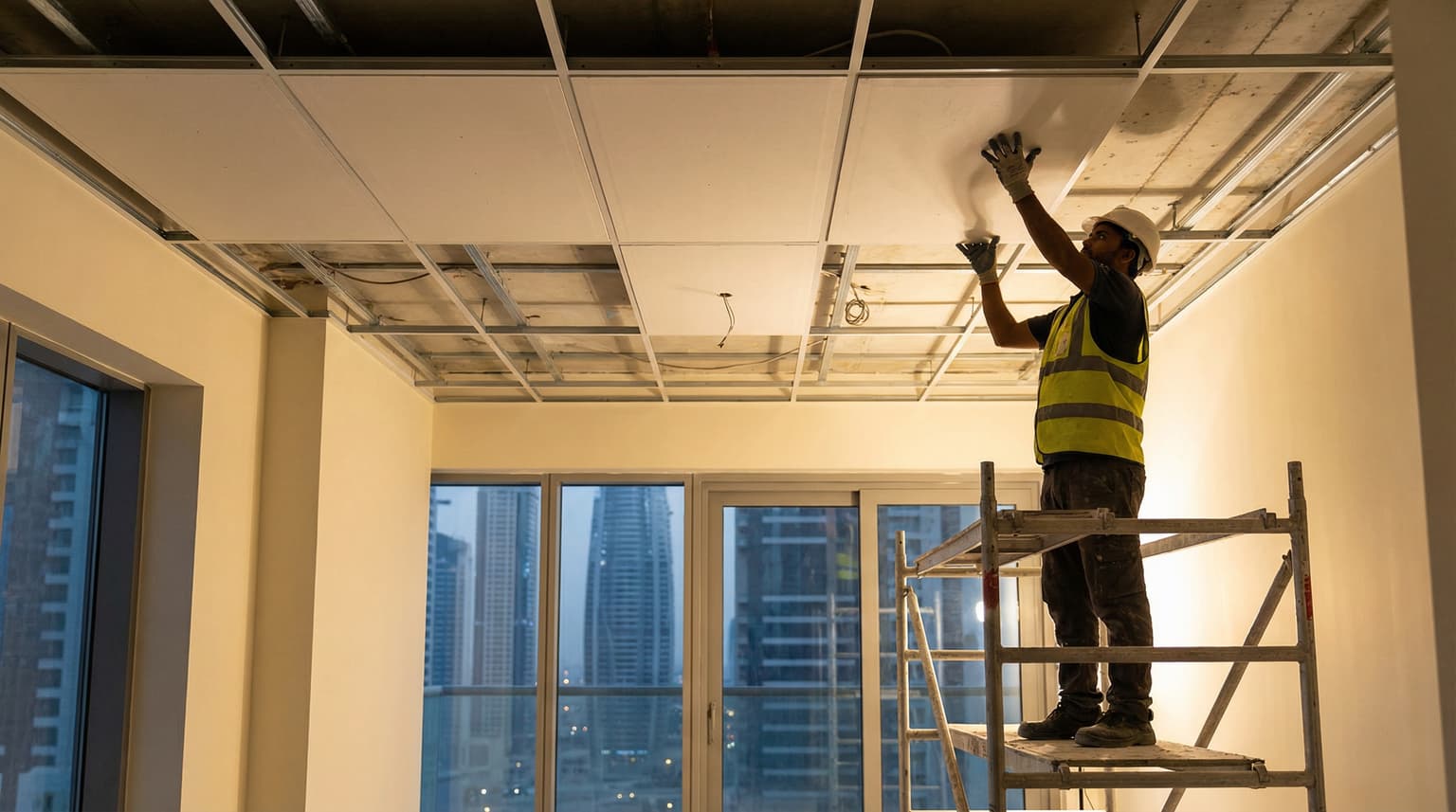
How it works: A metal grid of main runners and cross tees is suspended from the structural ceiling using wires. Mineral fibre tiles (standard 600 x 600 mm or 600 x 1200 mm) are simply laid into the grid. Tiles can be lifted out individually for maintenance access.
Best for: Offices, clinics, retail spaces, schools, and any commercial space where easy access to services above the ceiling is important.
Pros:
- Fast installation - a 50 sqm office can be done in a day
- Easy maintenance access - lift a tile, do the work, drop it back
- Good acoustic performance (NRC ratings of 0.55-0.90 depending on tile type)
- Fire-rated options widely available
- Cost-effective for large areas
Cons:
- The grid is visible - industrial look that doesn't suit residential spaces
- Tiles can sag or stain in humid conditions if low-quality tiles are used
- Limited design flexibility - it's a flat grid, no curves or drops
- Tiles are fragile and chip easily during handling
Dubai consideration: For Dubai's commercial fit-outs, the ceiling grid system must comply with Dubai Civil Defence fire safety requirements. Fire-rated tiles and grid components are mandatory in all commercial and public buildings. When specifying, confirm the tiles meet BS 476 or equivalent fire rating standards.
Metal False Ceiling
Metal ceilings come in several forms: aluminium strip ceilings, aluminium tile-in-grid systems, expanded metal mesh, and perforated panels.
How it works: Metal panels or strips are clipped or laid into a carrier system similar to a mineral fibre grid, but designed specifically for metal components. Some systems are snap-fit for a smooth look.
Best for: Outdoor covered areas, parking garages, swimming pool enclosures, industrial spaces, and modern commercial interiors where a clean, contemporary look is wanted.
Pros:
- Completely moisture-proof - won't sag, warp, or grow mould
- Extremely durable and long-lasting (20+ years)
- Easy to clean - wipe down with a damp cloth
- Available in a range of finishes (powder-coated, anodised, brushed, mirrored)
- Fire-resistant
Cons:
- Higher cost than gypsum or mineral fibre
- Limited acoustic performance unless perforated panels with backing pads are used
- Can feel cold or industrial in residential settings
- Condensation can form on metal surfaces in heavily air-conditioned spaces
Dubai consideration: Metal ceilings are the go-to choice for outdoor covered areas in Dubai - covered terraces, villa porticos, parking structures, and mall walkways. Gypsum and mineral fibre fail quickly in outdoor or semi-outdoor conditions here due to humidity and occasional rain. For outdoor applications, powder-coated aluminium with a minimum coating thickness of 60 microns is recommended.
PVC False Ceiling
PVC (polyvinyl chloride) panels are the budget option for false ceilings, popular in staff accommodation, storage areas, laundry rooms, and utility spaces.
How it works: Lightweight PVC panels (typically 200-300 mm wide, available in various lengths) interlock with tongue-and-groove joints and are fixed to a wooden or aluminium batten system. No finishing work needed - the surface comes pre-finished.
Best for: Bathrooms, laundry rooms, utility areas, staff accommodation, and budget-conscious projects where function matters more than aesthetics.
Pros:
- 100% waterproof - ideal for wet areas
- Cheapest false ceiling option
- Very fast installation - no taping, filling, or painting required
- Easy to clean
- Lightweight - minimal structural load
Cons:
- Looks cheap - visible panel joints and limited design options
- Prone to yellowing with UV exposure over several years
- Not fire-resistant (some grades are fire-retardant, but not fire-rated)
- Can't support heavy light fixtures - only lightweight LED panels
- Warps in extreme heat if installed in direct sun
Dubai consideration: PVC ceilings are commonly used in labour accommodation and maid's rooms throughout Dubai. They're practical for these applications. For living areas in apartments and villas, PVC looks out of place - stick with gypsum for residential rooms.
Stretch Ceiling
A newer option gaining traction in Dubai's luxury segment. A PVC or polyester membrane is heated, stretched across the room, and clipped into a perimeter track.
How it works: An aluminium or PVC track is fixed around the room perimeter. A thin membrane (0.17-0.25 mm thick) is heated with a hot air gun until pliable, then stretched and clipped into the track. Once cooled, it becomes taut and smooth.
Best for: High-end residential spaces, hotel lobbies, spas, feature rooms, and anywhere a dramatic or unusual ceiling effect is desired (backlighting, printed graphics, mirror finish).
Pros:
- Perfectly smooth, unbroken finish
- Available in hundreds of colours and finishes (matt, gloss, satin, translucent, printed)
- Can be backlit for dramatic effect
- Waterproof - actually holds water if there's a leak above (up to 100 litres per sqm)
- Fast installation for simple rooms (one day for 20-30 sqm)
Cons:
- Most expensive option per sqm
- Specialist installation required - not widely available in Dubai yet
- Can be punctured by sharp objects
- Limited repairability if damaged
- Access to services above requires detaching a section of membrane
Dubai consideration: Stretch ceilings are still niche in Dubai, mostly seen in five-star hotel projects and high-end villa renovations. Availability of qualified installers is limited compared to gypsum or grid ceiling contractors. If you're considering this, get references and see completed projects before committing.
False Ceiling Costs in Dubai (2026 Prices)
Pricing depends on the material, design complexity, room height, and whether existing ceilings need to be removed first. These are realistic market rates for 2026 based on contractor quotes in the Dubai market.
Material and Installation Costs
| Ceiling Type |
Cost per sqft (AED) |
Cost per sqm (AED) |
Notes |
| Gypsum board - flat, single level |
8 - 14 |
85 - 150 |
Most common residential choice |
| Gypsum board - with cove lighting |
14 - 22 |
150 - 240 |
Includes LED strip channel |
| Gypsum board - multi-level / custom |
20 - 35 |
215 - 375 |
Complex designs, curved elements |
| Mineral fibre grid (standard) |
6 - 10 |
65 - 110 |
Commercial grade, basic tile |
| Mineral fibre grid (premium acoustic) |
10 - 16 |
110 - 170 |
High NRC tiles, concealed grid |
| Metal ceiling - aluminium strip |
15 - 25 |
160 - 270 |
Outdoor rated, powder-coated |
| Metal ceiling - perforated panel |
18 - 30 |
195 - 320 |
With acoustic backing |
| PVC panels |
4 - 8 |
45 - 85 |
Budget option, utility areas |
| Stretch ceiling - standard |
25 - 40 |
270 - 430 |
Plain colours |
| Stretch ceiling - printed/backlit |
40 - 65 |
430 - 700 |
Custom designs, lighting effects |
Additional Costs
| Item |
Cost (AED) |
| Removal of existing false ceiling |
15 - 30 per sqm |
| Electrical work - recessed downlights (per point) |
80 - 150 |
| Electrical work - LED cove strip (per linear metre) |
45 - 90 |
| AC duct modifications |
500 - 2,000 (depends on scope) |
| Fire-rated board upgrade (gypsum) |
+15 - 25 per sqm |
| Moisture-resistant board upgrade (gypsum) |
+10 - 20 per sqm |
| Access panel installation (per unit) |
120 - 250 |
| Painting (after gypsum installation) |
8 - 15 per sqm |
Cost Examples for Common Projects
| Project |
Approximate Total (AED) |
| Studio apartment - flat gypsum ceiling (30 sqm) |
3,500 - 5,500 |
| 2-bedroom apartment - living + bedrooms (60 sqm) |
6,500 - 11,000 |
| Villa - ground floor living areas (120 sqm) |
13,000 - 22,000 |
| Office fit-out - mineral fibre grid (200 sqm) |
15,000 - 25,000 |
| Villa bathroom - MR gypsum (8 sqm) |
1,200 - 2,000 |
Note: These prices include material and labour. They don't include electrical work (lighting), AC modifications, or painting - which are often quoted separately. Always ask your contractor whether their quote is all-inclusive or ceiling-only.
False Ceiling Installation Process: What to Expect
Knowing what happens during installation helps you plan around the disruption and spot problems before they become expensive.
Step 1: Site Survey and Design
A contractor visits the property to measure rooms, cheque the structural ceiling height, note the position of existing services (AC ducts, electrical conduits, sprinklers), and discuss the design. For residential projects, this usually includes deciding on ceiling levels, lighting positions, and access panel locations.
Timeline: 1-2 hours for the survey. Design drawings take 2-5 days depending on complexity.
Step 2: Preparation
Furniture is moved or covered with dust sheets. The structural ceiling is cleaned and marked with reference lines for the new ceiling height. Anchor points are drilled for the suspension system. If existing AC ducts or wiring need to be repositioned, that work happens before the ceiling framework goes up.
Timeline: Half a day to one full day.
Step 3: System Installation
For gypsum ceilings, a metal framework of GI perimeter channels, main channels, and furring channels is suspended from the structural ceiling using adjustable hangers. The framework is levelled using a laser level - this is critical, because any error in the frame shows up as a visible wave in the finished ceiling.
For grid ceilings, main runners and cross tees are installed in a similar suspended arrangement, with the grid layout planned to centre tiles symmetrically in the room.
Timeline: 1-2 days for a typical apartment. 3-5 days for a villa.
Step 4: Services Rough-In
Before the ceiling boards go on, electricians run wiring for recessed lights, the AC contractor adjusts or extends duct runs, and any other services (speakers, smoke detectors, sprinklers) are positioned. Coordination between trades is important here - and it's where projects often hit delays if trades aren't scheduled properly.
Timeline: 1-3 days depending on the number of light points and AC modifications.
Step 5: Board/Tile Installation
Gypsum boards are cut to size and screwed to the system. Openings are cut for downlights, AC grilles, access panels, and sprinkler heads. For grid ceilings, tiles are simply dropped into the grid.
Timeline: 1-2 days for gypsum (per 50 sqm). Half a day for grid tiles (per 50 sqm).
Step 6: Finishing (Gypsum Only)
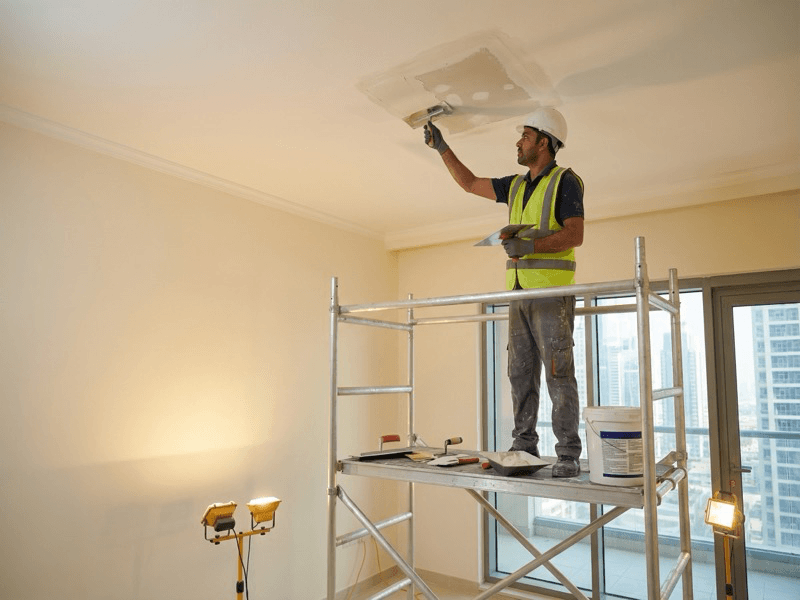
Joints between gypsum boards are taped with paper or fibreglass tape, covered with joint compound, sanded smooth once dry, and then primed and painted. This is the most labour-intensive part and the most visible - poor finishing shows up as visible lines or bumps once the paint goes on.
Timeline: 2-3 days (including drying time between compound coats).
Step 7: Final Fit-Out
Light fixtures, AC grilles, access panels, and other ceiling-mounted items are installed. The contractor does a final level cheque and touch-up.
Timeline: Half a day to one day.
Total timeline for a typical 2-bed apartment (gypsum ceiling, 60 sqm): 7-10 working days including electrical and painting.
Villa vs Apartment: Different Considerations
Apartments
False ceilings in Dubai apartments face a few specific constraints:
-
Height limitations. Many apartments have structural ceiling heights of 2.7-2.9 metres. After dropping the false ceiling by 15-20 cm, the finished height can feel tight - especially in smaller rooms. The minimum comfortable ceiling height is around 2.4 metres. Below that, the room feels compressed.
-
Building approvals. Some building management companies require written approval before any false ceiling work, particularly if it involves modifications to fire sprinkler systems or AC duct relocations. cheque with your building's facility management before signing a contract.
-
Noise from above. One of the main reasons apartment owners install false ceilings is noise from the unit above. For effective sound isolation, the ceiling needs insulation material (mineral wool or acoustic batts) in the cavity above the gypsum board. Without insulation, a gypsum false ceiling alone provides minimal acoustic improvement.
-
Sprinkler head repositioning. If the apartment has fire sprinklers (mandatory in most Dubai high-rises), the false ceiling must accommodate them. Sprinkler heads need to sit within specific distances of the finished ceiling surface per Dubai Civil Defence regulations. This sometimes requires repositioning sprinkler drops - which adds cost and requires a Civil Defence NOC (No Objection Certificate).
Villas
Villas offer more freedom but also more complexity:
-
Higher ceilings. Many Dubai villas have double-height living rooms (5-6 metres) or standard ceiling heights of 3.2-3.5 metres. This gives plenty of room for dramatic multi-level false ceiling designs without feeling cramped.
-
Outdoor areas. Villas often have covered terraces, porticos, and pool houses that need false ceilings. These outdoor or semi-outdoor applications require moisture-proof materials - metal or marine-grade gypsum board, never standard gypsum or mineral fibre.
-
More services to hide. Villas run more ductwork, more wiring, and sometimes have a whole-house audio system, CCTV cameras, and home automation cabling that all needs to route through the ceiling cavity.
-
Structural variety. Unlike apartments (which are basically concrete boxes), villas may have sloped roofs, wooden trusses, or varying ceiling heights between rooms. This makes system installation more complex.
Common False Ceiling Problems in Dubai
Cracks at Joints
The most common complaint with gypsum false ceilings. Cracks appear along the taped joints between boards, usually within the first year. Causes include:
- Building settling (common in newer properties)
- Thermal expansion and contraction from AC cycling
- Poor taping technique - insufficient compound, wrong tape type, or sanding before the compound fully dried
- System movement due to loose hangers
Fix: Minor cracks can be filled and repainted. Recurring cracks at the same joint suggest a framework issue - the fix is to add additional hangers or bracing near the affected joint.
Sagging
Gypsum board absorbs moisture and sags. In Dubai, this happens most often in:
- Bathrooms where standard (non-MR) gypsum was used instead of moisture-resistant board
- Kitchens above cooking areas where steam rises constantly
- Rooms directly below a flat roof with poor waterproofing (water seeps through the slab)
Fix: Sagging boards must be replaced - they don't recover once waterlogged. Address the moisture source first, then install MR board.
Water Stains and Leaks
Brown stains on a false ceiling almost always indicate a water leak above - from plumbing, AC condensate drain, or roof waterproofing failure. The false ceiling hides the problem until enough water accumulates to stain or bulge the board.
Fix: Find and fix the leak first. Then replace stained boards, treat any mould growth on the system with anti-fungal spray, and repaint.
Popping Screws
Screw heads pushing through the surface of painted gypsum. This happens when the system shifts and pulls on the screw, or when screws were over-driven during installation (breaking through the paper face of the gypsum board, weakening the hold).
Fix: Remove the popped screw, drive a new screw 25-50 mm away from the original hole, patch the old hole with compound, and repaint.
AC Grille Condensation
In Dubai's humidity, cold air from AC grilles can cause condensation on the ceiling surface around the grille - leading to water stains, mould, and paint peeling.
Fix: Ensure the area around AC grilles is properly insulated. Use insulated flexible duct for the final connection to the grille. Apply anti-condensation paint or insulation wrap around the boot connection.
False Ceiling Maintenance Tips
-
Inspect annually for cracks and stains. Walk every room and look up. Catching a water stain early can save you a major leak repair later.
-
Keep AC systems maintained. A blocked AC condensate drain is one of the most common causes of false ceiling water damage in Dubai. Regular AC maintenance prevents this.
-
Repaint gypsum ceilings every 3-5 years. Ceiling paint yellows and collects dust over time. A fresh coat of white ceiling paint (use a flat/matt finish to hide imperfections) refreshes the look.
-
Don't hang heavy items from the false ceiling. False ceilings are designed to support their own weight plus light fixtures. Ceiling fans, heavy chandeliers, and projector mounts must be anchored to the structural ceiling above - not the false ceiling framework. Professional ceiling fan installation ensures proper anchoring.
-
Clean grid ceiling tiles regularly. Mineral fibre tiles in offices absorb dust and can harbour mould. Vacuum with a soft brush attachment or replace stained tiles - they're cheap and interchangeable.
-
Maintain access panels. Make sure access panels open freely and aren't painted shut. You'll need them when servicing AC units, fixing electrical issues, or dealing with leaks.
-
Address mould immediately. If you spot black or green spots on the ceiling surface or around AC grilles, clean with a mould-specific treatment and identify the moisture source. Dubai's humidity makes mould a recurring problem if the underlying cause isn't resolved.
Dubai Building Regulations for False Ceilings
False ceiling installations in Dubai are subject to several regulatory requirements:
Dubai Civil Defence (DCD): All commercial false ceilings must use fire-rated materials and maintain proper clearance for fire sprinkler systems. Sprinkler heads must be visible below the false ceiling and positioned according to DCD standards. Residential properties in high-rise buildings also need to comply with sprinkler regulations.
Dubai Municipality Building Code: Minimum finished ceiling heights apply. Residential rooms must maintain a minimum ceiling height of 2.4 metres after false ceiling installation. cheque your specific building's regulations - some communities have additional requirements.
DEWA coordination: If the false ceiling project involves electrical work (which it almost always does), the electrical work must comply with DEWA's wiring regulations. In commercial properties, electrical modifications require a DEWA NOC.
Ejari and RERA: If you're a tenant installing a false ceiling, cheque your tenancy contract. Most residential leases require landlord approval for structural modifications (which false ceilings are sometimes classified as). Get written approval before starting work.
How to Choose a False Ceiling Contractor in Dubai
The same principles that apply to choosing any home maintenance contractor in Dubai apply here, with a few ceiling-specific additions:
Trade licence. The contractor must hold a valid Dubai DED trade licence covering interior fit-out or general maintenance work.
Portfolio of completed projects. Ask for photos of completed false ceiling projects - specifically, projects similar in scope to yours. A contractor who specialises in office grid ceilings may not deliver the finish quality you want for a residential gypsum ceiling.
Material specifications. A professional contractor will specify exactly which materials they'll use: board brand and type (Knauf, Gyproc, USG), framework specification, suspension system, and fire rating if applicable. "We use good quality gypsum" isn't a specification.
Coordination with other trades. If your project involves electrical work, AC modifications, or painting, the ceiling contractor should either handle all trades in-house or have a clear coordination plan. False ceiling projects that involve multiple uncoordinated subcontractors tend to drag on and produce inconsistent results.
Warranty. Look for a minimum 12-month warranty covering cracking, sagging, and system defects. Given that joint cracking is so common, confirm whether the warranty covers joint crack repairs or excludes them (some contractors do).
Written, itemised quotation. The quote should break down:
- System and suspension (per sqm)
- Board supply and installation (per sqm)
- Finishing - taping, filling, sanding (per sqm)
- Painting (per sqm)
- Access panels (per unit)
- Electrical and lighting (itemised)
- Removal of existing ceiling (if applicable)
- Cleanup and disposal
Frequently Asked Questions
How much does a false ceiling cost per square foot in Dubai?
Basic flat gypsum board ceilings cost AED 8-14 per square foot including material and labour. With cove lighting, expect AED 14-22 per square foot. Multi-level or custom designs with curves and drops run AED 20-35 per square foot. Commercial mineral fibre grid ceilings are cheaper at AED 6-10 per square foot. These prices are material and installation only - electrical work, AC modifications, and painting are usually quoted separately.
How long does false ceiling installation take?
For a standard 2-bedroom apartment (around 60 sqm of ceiling area), a flat gypsum ceiling takes 7-10 working days from system installation through to final painting. A grid ceiling in a 200 sqm office takes 3-5 days. Simple single-room jobs (a bedroom or bathroom) can be done in 3-4 days. Multi-level gypsum designs with complex lighting add 3-5 extra days.
Can I install a false ceiling in a rented apartment in Dubai?
Technically, yes - but you need written permission from your landlord. The tenancy contract typically covers modifications to the property. Some landlords allow it on the condition that you either leave the ceiling in place when you vacate or restore the original ceiling at your own cost. Get the agreement in writing before spending money on installation.
Is gypsum or PVC better for bathroom ceilings in Dubai?
For bathrooms, both work - but they serve different budgets and aesthetics. Moisture-resistant (MR) gypsum board gives a smooth, paintable finish that looks like the rest of the house. It costs more and requires proper ventilation to perform well long-term. PVC is fully waterproof, cheaper, and easier to install, but has visible panel joints and a more utilitarian look. For master bathrooms and guest bathrooms that visitors see, MR gypsum is the better choice. For maid's rooms, utility bathrooms, and laundry areas, PVC makes practical sense.
Do false ceilings reduce room height?
Yes. A standard false ceiling requires a minimum drop of 10-15 cm from the structural ceiling - more if AC ducts or other services need to pass through the cavity. In practise, most residential installations drop 15-25 cm. This means a room with a 2.9-metre structural ceiling will have a finished height of around 2.65-2.75 metres. In rooms with ceiling heights below 2.7 metres, a false ceiling can make the space feel cramped. For low-ceiling rooms, consider a partial false ceiling (around the perimeter only) rather than covering the entire ceiling.
What's the difference between a false ceiling and a gypsum partition?
A false ceiling is a horizontal secondary ceiling suspended below the structural ceiling. A gypsum partition is a vertical wall divider made from the same gypsum board material but built on a floor-to-ceiling steel stud system. They use similar materials but serve completely different purposes. Both are common in Dubai fit-out projects - offices, for example, often install both gypsum partitions to divide space and a grid false ceiling above.
How do I know if my false ceiling needs replacing?
Warning signs that indicate replacement rather than repair: widespread cracking across multiple joints (suggests a framework problem), visible sagging (moisture damage to the gypsum board), recurring water stains in the same area (active leak above), mould growth that keeps returning after treatment, and a ceiling that moves or feels soft when touched. Single cracks, isolated stains, and minor cosmetic issues can usually be repaired without replacing the entire ceiling. A professional assessment will clarify which approach makes sense for your situation.
Professional False Ceiling Services in Dubai
Whether you need a new gypsum false ceiling installed, an existing ceiling repaired, or a commercial grid ceiling replaced, European Technical handles the full scope of false ceiling work across Dubai.
Our services cover residential and commercial projects - from single-room ceiling repairs in apartments to full villa false ceiling installations with multi-level designs and integrated lighting. We coordinate all trades in-house: ceiling framework and boarding, electrical and lighting, painting and finishing, and AC modifications where needed.
Call us on +971 4 256 6714 or request a free quote online to discuss your false ceiling project.
We serve all areas including Downtown Dubai, Dubai Marina, JVC, Arabian Ranches, Palm Jumeirah, Business Bay, JLT, Dubai Hills, Damac Hills, Al Barsha, DIFC, Jumeirah, and Dubai Silicon Oasis.