Water Tank Cleaning Dubai: How Often Should You Do It?
If you live in Dubai, you rely on a stored water supply for bathing, cooking, and cleaning. The water feeding your taps sits in a tank on your roof or in a plant room before it reaches your shower. In a climate where summer temperatures regularly push past 45°C and humidity remains high for months, that stored water needs careful management. One of the most common questions we receive from homeowners and tenants is simple. How often should you clean your water tank in Dubai?
The answer is legally defined. Dubai Municipality requires water tank cleaning every six months. This is not a suggestion or a best practice guideline. It is a legal requirement under Dubai Municipality By-Law No. 11 of 2003. All residential and commercial property owners must maintain their water storage systems to this standard. Failure to comply can result in fines reaching AED 50,000.
At European Technical, we handle water tank cleaning for properties across Dubai. We see the effects of neglected tanks in apartments in Dubai Marina and villas in Arabian Ranches. The good news is that keeping your water supply safe is straightforward when you follow the correct schedule and use a Dubai Municipality approved specialist.
The Legal Requirement: Dubai Municipality By-Law No. 11 (2003)
Dubai takes water safety seriously. The municipality introduced By-Law No. 11 in 2003 to regulate water storage and ensure public health. The law states that all residential and commercial property owners must clean and disinfect their water tanks at least once every six months.
This six month interval is the minimum standard. The reasoning is practical. Over six months, sediment from the mains supply settles at the bottom of your tank. Bacteria can multiply. Algae can form on the walls if the tank is exposed to any light. The warm temperatures in Dubai accelerate this biological activity. By cleaning the tank twice a year, you remove these build-ups before they affect your water quality.
For some properties, the six month rule is a starting point rather than a complete solution. Older tanks, or tanks located in direct sunlight on exposed rooftops, may need more frequent attention. Commercial properties with high water turnover, or buildings in areas with particularly hard water, often require cleaning every three to six months. We assess each tank individually to determine the right schedule for the specific conditions.
When you hire a DM approved specialist for the cleaning, you should receive an official compliance certificate on the same day. This document is your proof that you have met your legal obligations. If you are a tenant, you can ask your building management for water testing and tank cleaning records. If you own the property, you are responsible for ensuring these records exist and are up to date.
Why Dubai's Climate Makes Frequent Cleaning Essential
The climate in Dubai creates specific challenges for water storage that make the six month cleaning interval non-negotiable. Understanding these challenges helps explain why the municipality set this standard.
Heat is the primary factor. Water stored in a tank on a roof in JVC or Business Bay absorbs heat throughout the day. Warm water is an ideal environment for bacterial growth. Legionella, a bacteria that causes serious respiratory illness, thrives in warm water between 20°C and 45°C. Without regular disinfection, your tank could become a breeding ground.
Humidity adds another layer of risk. Dubai's coastal areas like Dubai Marina and Palm Jumeirah experience high humidity levels. This moisture affects the external surfaces of tanks and can contribute to condensation inside, particularly in poorly sealed units. Condensation introduces additional water that can carry contaminants.
Sediment is a persistent issue. The mains water supply in Dubai is safe when it leaves the treatment plant, but it travels through kilometres of pipe before reaching your building. Small particles of rust, sand, and mineral deposits enter your tank along with the water. These particles settle at the bottom. Over time, they create a layer of sludge that reduces your tank's capacity and provides a surface for bacteria to colonise.
In areas like Arabian Ranches and other villa communities, the problem can be more pronounced. Villas often have larger tanks that store water for longer periods. The longer water sits, the more likely it is to develop quality issues. A villa tank that is not cleaned for a year can accumulate a surprising amount of sediment.
Health Risks of Neglecting Water Tank Cleaning
The consequences of skipping water tank cleaning go beyond a legal fine. Contaminated water poses real health risks to you and your family.
Bacterial contamination is the most serious concern. When a tank is not cleaned and disinfected regularly, bacteria multiply in the warm, stagnant water. If you ingest this water, you risk gastrointestinal infections, diarrhoea, and vomiting. For young children, the elderly, and anyone with a compromised immune system, these infections can be severe.
Biofilm formation is another hidden danger. Bacteria in water tanks do not always float freely. They attach to the walls of the tank and form a thin, slimy layer called a biofilm. Biofilms protect bacteria from standard disinfection methods. If a biofilm has developed, a simple chlorine treatment may not be enough. The tank needs thorough mechanical cleaning followed by disinfection to remove the biofilm completely.
Algae growth occurs when light enters the tank. Some older plastic tanks, or tanks with damaged covers, allow sunlight to penetrate. Algae turns the water green and creates an unpleasant smell. While algae itself is not always directly harmful, its presence indicates that other organisms could be thriving in the same conditions.
Corrosion affects metal tanks and components. Over time, the minerals in Dubai's water can corrode the internal surfaces of certain tanks. Corrosion introduces metal particles into your water supply and can eventually cause leaks. Regular cleaning allows technicians to spot early signs of corrosion before they become structural failures.
The cost of cleaning a water tank in Dubai is modest compared to the potential costs of neglecting it. A standard residential tank cleaning typically ranges from AED 250 to AED 600 depending on the size and type of tank. Compare this to the AED 50,000 fine for non-compliance, or the medical costs of a family falling ill from contaminated water.
What Professional Water Tank Cleaning Involves
Understanding the cleaning process helps you know what to expect and ensures you hire a company that does the job properly. A professional water tank cleaning service in Dubai follows a systematic approach.
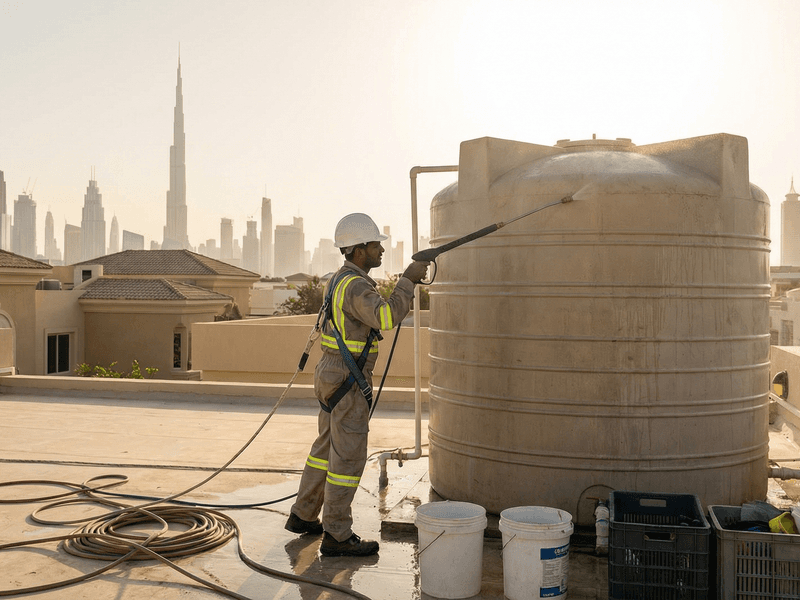
The process begins with draining the tank. Technicians empty the water completely to expose the interior surfaces. They then inspect the tank for signs of damage, cracks, or corrosion. This inspection is valuable. Catching a small crack early can prevent a major leak later.
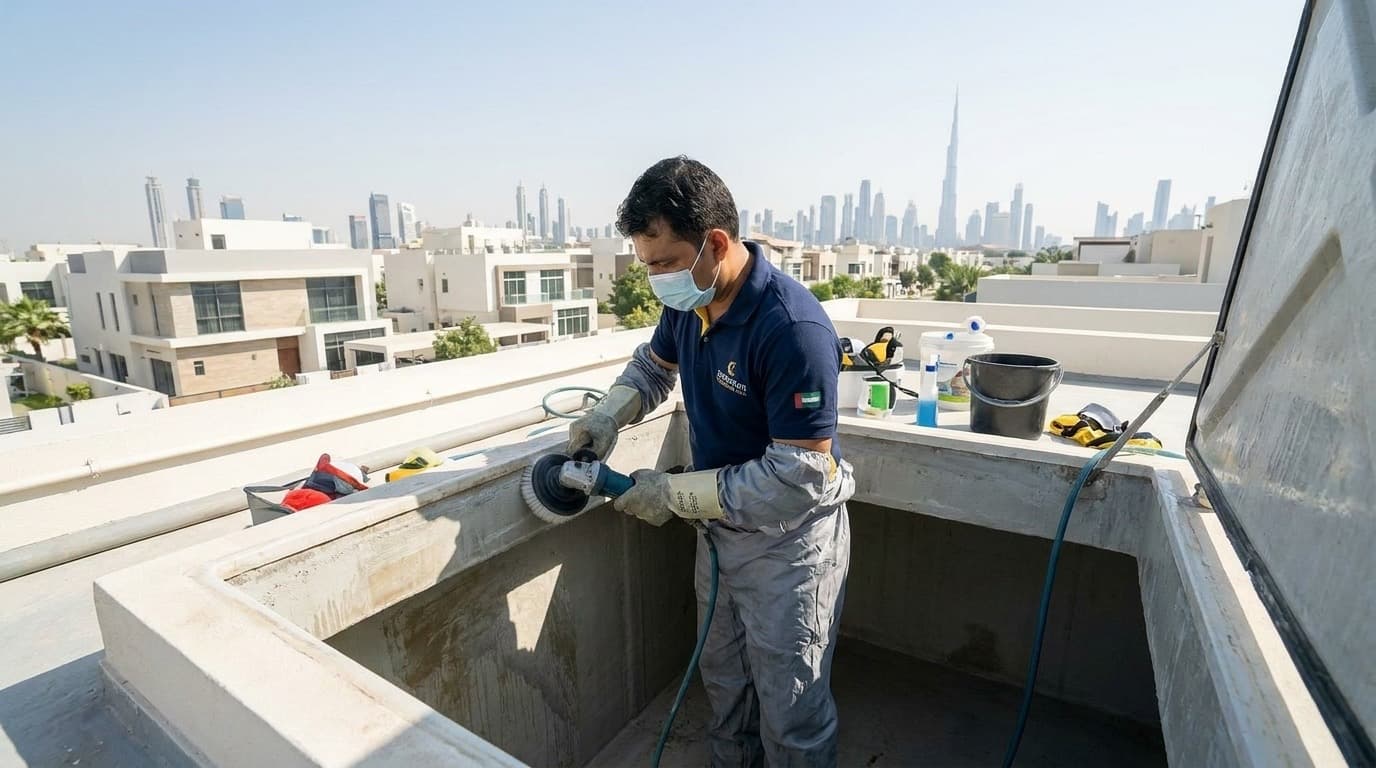
Next comes mechanical cleaning. Technicians enter the tank, wearing appropriate protective equipment, and scrub the interior walls, floor, and ceiling. They remove all sediment, scale, and biofilm. For tanks in areas with hard water, this descaling step is particularly important. The mineral build-up in Dubai water can be stubborn and requires physical effort to remove.
After mechanical cleaning, the team vacuums out the loosened debris and flushes the tank with clean water. Then they apply a disinfectant. Dubai Municipality approved cleaning companies use food safe disinfectants that kill bacteria without leaving harmful residues. The disinfectant needs to sit for a specific contact time to be effective. The team then flushes the tank again to remove all traces of the disinfectant.
Finally, the tank is refilled and the water is tested. A reputable company will provide a compliance certificate confirming the cleaning has been completed to Dubai Municipality standards.
The entire process typically takes two to four hours for a standard residential tank. For larger commercial tanks, it can take a full day. You should plan to have alternative water access during the cleaning, or schedule it when water usage is low.
If your tank needs repairs, a professional handyman can address issues like damaged covers, faulty float valves, or leaking connections. Fixing these problems promptly extends the life of your tank and improves water quality.
Choosing the Right Cleaning Schedule for Your Property
The six month rule applies to all properties in Dubai. However, your specific circumstances may warrant a different approach.
For apartments in towers in Downtown Dubai or Business Bay, the building management typically handles water tank cleaning as part of their maintenance responsibilities. As a tenant, you have the right to ask for proof that the tanks have been cleaned on schedule. Ask for the compliance certificate and the cleaning records. If the management cannot provide these, you can request that they arrange a cleaning immediately.
For villas in communities like Arabian Ranches, The Springs, or JVC, the responsibility usually falls on the owner. If you own the villa, you need to arrange the cleaning yourself or through your annual maintenance contract. If you rent, check your tenancy agreement. In most cases, the landlord is responsible for the structural maintenance of the water system, including tank cleaning.
Commercial properties face stricter requirements due to higher usage and the public nature of the water supply. Restaurants, clinics, and gyms should clean their tanks every three to six months. If your business serves vulnerable populations, such as a nursery or a care facility, consider the more frequent end of that range.
Older properties need special attention. If your building is more than ten years old, the tank and pipe infrastructure may be more susceptible to contamination. In these cases, we recommend sticking rigidly to the six month schedule and considering additional water testing between cleanings.
Properties with exposed rooftop tanks should also consider more frequent cleaning. The sun heats these tanks intensely during summer, accelerating bacterial growth. If your tank is on the roof without shade, a four month cleaning interval may be more appropriate.
Integrating Water Tank Cleaning with Your Home Maintenance Plan
Water tank cleaning should not be an isolated task. It works best as part of a broader home maintenance strategy. Dubai properties face multiple maintenance challenges due to the climate, and addressing them together is more efficient.
Your cleaning schedule can align with other seasonal tasks. Many of our clients book their first tank cleaning in April, before the peak summer heat arrives. The second cleaning follows in October, as temperatures begin to drop. This timing ensures the tank is clean before the most challenging months and is refreshed after them.
During a maintenance visit, technicians can also check related systems. The pipes connecting your tank to your taps, the water pump, and the pressure system all affect your water quality and supply. A problem with your pump can cause low pressure that makes showers frustrating and affects appliance performance. Scheduling these checks alongside tank cleaning saves time and ensures your entire water system is functioning correctly.
For property owners who rent out their properties, regular maintenance is particularly important. A tenant who experiences water quality issues will complain, and rightly so. Staying ahead of the maintenance schedule prevents these problems and protects your investment. An annual maintenance contract that includes water tank cleaning, AC servicing, and general plumbing checks is a practical solution for landlords.
You can also arrange for plumbing services to inspect your pipe connections during the same visit, ensuring there are no leaks or contamination points between the tank and your taps.
Signs Your Water Tank Needs Cleaning Sooner Than Scheduled
Even with a regular six month schedule, you should watch for signs that your tank needs attention immediately. These indicators suggest a problem that should not wait.
Discoloured water is the most obvious sign. If the water from your taps has a brown, yellow, or rusty tint, sediment has built up in your tank. This is common in older buildings and in areas where the mains supply carries more particulates. Run the cold tap for a few minutes. If the discolouration persists, call a cleaning service.
An unusual smell from the water indicates bacterial growth or contamination. The water should have no odour. If you notice a rotten egg smell, this suggests hydrogen sulphide gas, which is produced by certain bacteria. A musty or earthy smell can indicate algae. Either way, the tank needs cleaning and disinfection.
A change in water pressure can also point to a tank issue. If the pressure drops suddenly, the tank may have a blockage or a faulty valve. While this is not always a cleaning issue, it requires investigation.
Visible debris in the water, such as particles or strands of material, means the tank has significant contamination. Stop using the water for drinking and cooking and arrange a cleaning immediately.
If anyone in your household experiences unexplained stomach upsets or skin irritation, the water supply could be a factor. While many illnesses have other causes, persistent issues that affect multiple family members warrant a water quality test.
The Cost of Compliance Versus the Cost of Neglect
Some property owners view water tank cleaning as an unnecessary expense. This is a short sighted perspective that ignores both the legal and practical realities.
The financial cost of compliance is straightforward. Two professional cleanings per year for a typical residential tank costs between AED 500 and AED 1,200 in total. This includes the cleaning, disinfection, and compliance certificate. For most households, this is a modest expense that amounts to less than AED 100 per month.
The cost of neglect is harder to quantify but significantly higher. The AED 50,000 municipality fine is the most visible penalty. But the hidden costs are worse. Contaminated water can cause illness that leads to medical bills and lost work days. A corroded tank that is not inspected can leak, causing water damage to your property. A tank that fails completely needs replacement, which costs thousands of dirhams.
There is also a legal liability aspect. If you are a landlord and your tenant becomes ill because of a dirty water tank, you could be held responsible. Tenants have the right to safe living conditions, and water quality is a fundamental part of that.
For businesses, the stakes are even higher. A restaurant or clinic that serves contaminated water risks its licence, its reputation, and legal action. The cost of a single incident far exceeds years of regular cleaning.
FAQ
How often should water tanks be cleaned in Dubai?
Dubai Municipality mandates that all residential and commercial water tanks be cleaned at least once every six months under By-Law No. 11 of 2003. This is a legal requirement, not a recommendation. Some properties with older tanks, exposed rooftop tanks, or commercial operations may need cleaning every three to four months.
What happens if I do not clean my water tank on schedule?
Non-compliance with Dubai Municipality regulations can result in fines up to AED 50,000. Beyond the financial penalty, a neglected tank can develop bacterial contamination, sediment build-up, and biofilm. This poses health risks to anyone using the water and can cause long term damage to your plumbing system.
Can I clean my water tank myself?
Water tank cleaning in Dubai must be carried out by a Dubai Municipality approved specialist. Professional cleaning involves draining, mechanical scrubbing, disinfection with approved chemicals, and flushing. A certified company provides a compliance certificate on completion. Self cleaning does not meet legal requirements and may not effectively remove biofilm or bacteria.
Who is responsible for water tank cleaning in a rented property?
In most rental agreements in Dubai, the landlord or building management is responsible for water tank cleaning and structural maintenance of the water system. Tenants can request the cleaning records and compliance certificate from their building management. If the records are not available, the tenant has the right to ask for a cleaning to be arranged.
How long does a professional water tank cleaning take?
A standard residential water tank cleaning typically takes between two and four hours. This includes draining the tank, mechanical cleaning, disinfection, flushing, and refilling. Larger commercial tanks may take a full day. You should plan for limited water access during the cleaning process.
What does water tank cleaning cost in Dubai?
The cost of cleaning a residential water tank in Dubai typically ranges from AED 250 to AED 600 per cleaning, depending on the size and type of tank. Most properties need two cleanings per year, bringing the annual cost to between AED 500 and AED 1,200. This is significantly less than the potential fines for non-compliance.