Electrical Safety Starts at Your DB Box
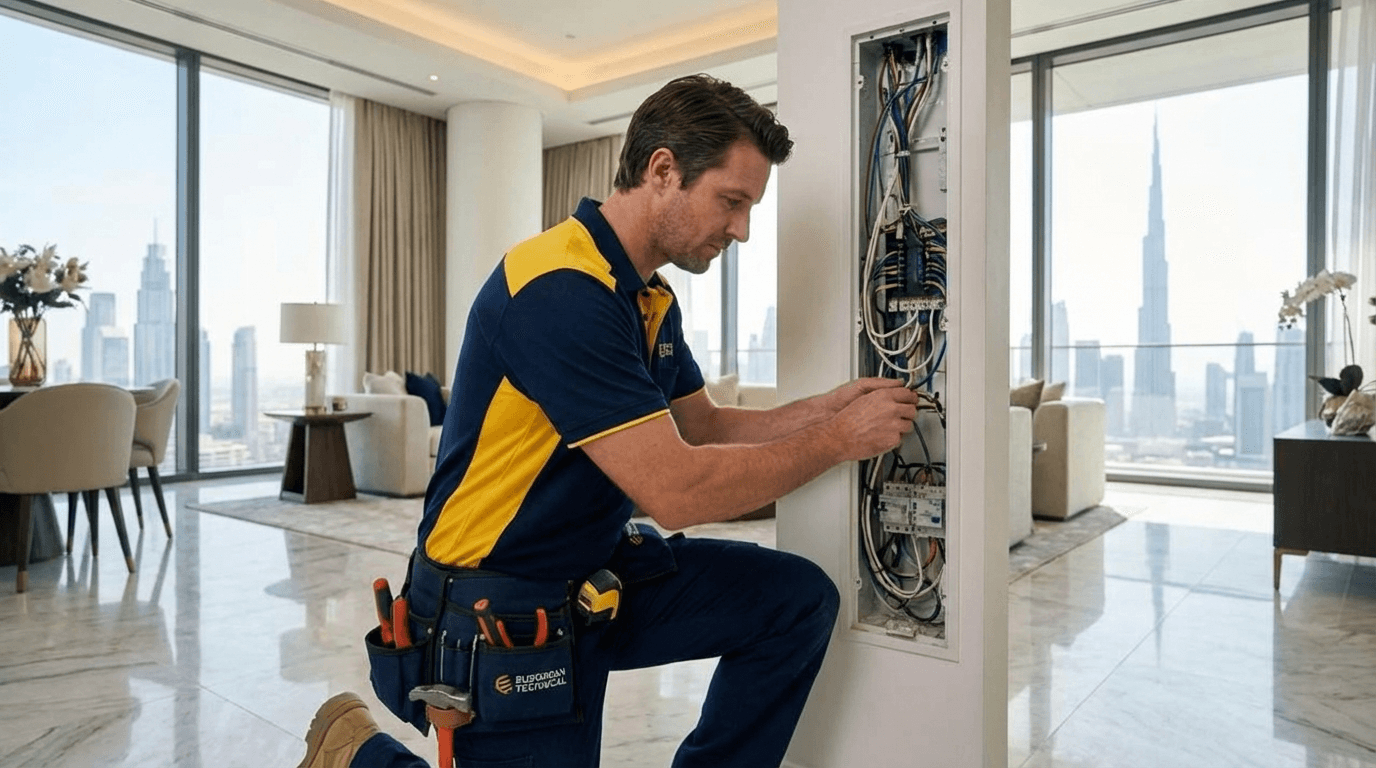
Every apartment and villa in Dubai has a distribution board (DB box) — that metal panel with rows of switches usually tucked inside a cupboard near the front door. Most people ignore it until something trips. That's a mistake. Understanding your DB box is the difference between resetting a nuisance trip and standing in a dark apartment at midnight with no idea what went wrong.
This guide covers everything a Dubai resident needs to know about electrical safety — from your circuit breakers and DEWA compliance, to the real risks of extension cords and overloaded sockets, bathroom-specific regulations, and when your apartment needs rewiring.
Understanding Your Distribution Board (DB Box)
What's Inside
Open your DB box. You'll see rows of switches — these are your circuit breakers (MCBs — Miniature Circuit Breakers) and residual current devices (RCDs/RCBOs). Each one protects a specific circuit in your home.
- MCBs (Miniature Circuit Breakers): Protect against overload and short circuits. If you plug too many devices into one circuit or a wire shorts out, the MCB trips and cuts power to that circuit. Common ratings in Dubai apartments: 6A (lighting), 16A (general sockets), 20A (AC units), 32A (cooker/oven).
- RCDs (Residual Current Devices): Protect against earth faults — the kind that electrocute people. If current leaks through your body to earth (e.g., touching a faulty appliance while standing on a wet floor), the RCD trips in under 30 milliseconds. These save lives.
- RCBOs: Combined MCB + RCD in one unit. Found in newer installations. When an RCBO trips, only that specific circuit loses power, not the whole group.
- Main switch: The large switch at the top — cuts all power to the apartment. Use this if you need to shut everything off in an emergency.
What the Labels Mean
Most DB boxes in Dubai are labelled (sometimes in English, sometimes in Arabic, sometimes not at all). Common circuit labels:
| Label | What It Powers | Typical Rating |
|---|
| Lights / LTG | Ceiling lights and switches | 6A or 10A |
| Sockets / PWR | Wall outlets — general use | 16A |
| AC-1, AC-2, etc. | Individual AC units or FCUs | 16A or 20A |
| WH / Water Heater | Water heater | 16A or 20A |
| Cooker / Oven | Kitchen cooker circuit | 32A |
| W/M or Washer | Washing machine | 16A or 20A |
| D/W | Dishwasher | 16A |
If your DB box isn't labelled, do it yourself. Switch off each breaker one at a time and note what stops working. Write it on the inside of the panel door. Takes 20 minutes and saves you real trouble during an emergency.
DEWA Electrical Compliance
DEWA sets the standards for electrical installations in Dubai, aligned with the DEWA Regulations for Electrical Installations (commonly called the "Green Book") and supplemented by UAE fire and safety codes.
Key Requirements for Residential Properties
- All electrical work must be performed by DEWA-approved contractors. This includes wiring modifications, DB box upgrades, and new circuit installations. Unlicensed work can result in DEWA refusing to connect or reconnect supply.
- Electrical installations require a DEWA completion certificate before supply is connected. For new buildings, this is handled by the developer. For modifications, the contractor submits the completion notice.
- RCD protection is mandatory on all socket circuits in new installations. Older buildings may not have RCDs — if yours doesn't, getting them retrofitted is a safety priority.
- Earthing must comply with DEWA standards. Every socket must have an earth connection. Two-pin sockets (common in older buildings in Deira and Bur Dubai) are non-compliant and should be replaced.
- Smoke and heat detectors are mandatory in Dubai. Many are hard-wired into the electrical system. Do not disconnect or cover them — it's a fire code violation and Dubai Civil Defence can fine you.
Meter Tampering
Tampering with a DEWA meter is a criminal offence under UAE Federal Law. DEWA conducts inspections and uses smart meters to detect anomalies. The penalties include disconnection, backdated billing at commercial rates, fines, and potential prosecution. If you notice your meter has been tampered with (e.g., seals broken, wires bypassing the meter), report it to DEWA immediately — you don't want to be the one holding the liability when the inspection happens.
Extension Cords and Multi-Socket Adaptors: The Real Risk
Extension cords and multi-way adaptors cause more apartment fires in Dubai than almost any other single factor. Here's why, and how to use them safely — or better yet, avoid them.
The Problem
- Daisy-chaining: Plugging one extension into another. Each connection adds resistance, which generates heat. Two extensions in series powering a heater or iron is a fire waiting to happen.
- Overloading: A standard UK-style 13A socket delivers a maximum of about 3,000 watts. A multi-way adaptor plugged into that socket still has the same 3,000W limit — it doesn't multiply the capacity. Plug a washing machine, dryer, and kettle into one adaptor and you're drawing 6,000-7,000W through a connection rated for 3,000W.
- Cheap products: Dragon Mart sells multi-socket boards for AED 10-15. Many have no overload protection, use thin copper wiring, and have loose socket contacts that arc and generate heat. Spend AED 40-60 on a branded board with an overload cut-off (Brennenstuhl, Belkin, or any board with a BS 1363 rating).
- Running under carpets or through doorways: Compressed cables overheat. Damaged insulation from foot traffic exposes live wires. Extension cords must be fully unwound (coiled cords overheat) and not covered.
Safe Practice
- Use extension cords as temporary solutions only — if you permanently need power somewhere, get an electrician to install a proper socket.
- Never exceed 3,000W total on any single extension board or adaptor.
- Never daisy-chain extensions.
- Buy boards with individual switches per socket — switch off what you're not using.
- Never run extension cords through water (kitchen counters near sinks, bathroom floors).
- Unplug extension boards during lightning storms. Dubai gets intense electrical storms in winter and spring — direct strikes and surges kill electronics and can ignite extension boards.
Bathroom Electrical Regulations in Dubai
Bathrooms are the most dangerous room for electrical accidents because water and electricity coexist. Dubai follows strict zoning rules for electrical installations in bathrooms.
IP Zones
Dubai building codes define zones around the bath/shower area where electrical equipment must meet specific protection ratings:
| Zone | Area | What's Allowed |
|---|
| Zone 0 | Inside the bath or shower tray | Only SELV (Safety Extra Low Voltage) devices rated IPX7 (submersible). Practically nothing should be here. |
| Zone 1 | Above the bath/shower to 2.25m height | IPX4 rated equipment only (splash-proof). Water heaters and shower units with proper IP rating can be installed here by a licensed electrician. |
| Zone 2 | 0.6m beyond Zone 1 (horizontally) | IPX4 rated equipment. Shaver sockets with isolating transformers. Ventilation fans with appropriate IP rating. |
| Outside zones | Beyond Zone 2 | Standard equipment permitted, but RCD protection still required on all circuits serving the bathroom. |
Practical Rules
- No standard sockets inside bathrooms. The only socket type permitted in a Dubai bathroom is a shaver socket with an isolating transformer (the two-pin type with a built-in voltage selector). These limit current to non-lethal levels.
- Light switches should be outside the bathroom or be pull-cord type inside. In many Dubai apartments, the switch is outside the door. If you have a standard flip switch inside a bathroom, it should be at least 0.6m from any water source.
- Towel warmers and heated mirrors must be hardwired (not plugged in) and installed by a licensed electrician with proper IP-rated connections.
- Hair dryers, straighteners, and electric shavers: Use them away from water. Never use a plugged-in device near a full sink or bath. If a device falls into water, do not reach in — switch off the circuit breaker first.
Common Electrical Problems in Dubai Apartments
Frequently Tripping Breakers
If the same breaker trips repeatedly, there's an underlying issue — not just a nuisance. Common causes:
- Overloaded circuit: Too many devices on one circuit. Common in older apartments where a single 16A circuit serves an entire bedroom including the AC. Solution: redistribute the load or install an additional circuit.
- Faulty appliance: Unplug everything on that circuit. Reset the breaker. Plug devices back in one at a time. When the breaker trips, that's your faulty device.
- Moisture ingress: Water in a socket box (from AC condensate leaks, bathroom splash, or rainwater through a window) causes RCD trips. This is common in ground-floor apartments and buildings near the sea (JBR, Palm Jumeirah).
- Worn breaker: MCBs and RCDs have a lifespan. After 15-20 years, the trip mechanism weakens and nuisance trips increase. Replacement is AED 50-150 per device — straightforward for a licensed electrician.
Flickering Lights
- Single light: Loose bulb, failing LED driver, or loose connection at the light fitting. Tighten the bulb first. If it continues, the fitting needs checking.
- Multiple lights on one circuit: Loose connection at the DB box or a failing neutral connection. This needs an electrician — loose neutrals cause voltage fluctuations that damage electronics.
- All lights in the apartment: Could be a DEWA supply issue. Check with neighbours — if they have the same problem, report to DEWA (991). If it's only you, your main connection has an issue.
Warm or Discoloured Sockets
A socket that's warm to the touch or shows brown/black marks around the plug entry is a fire hazard. Loose internal connections cause arcing, which generates intense heat. Switch off the breaker for that circuit immediately and call an electrician. Do not use the socket until it's been replaced and the wiring checked.
Burning Smell from Sockets or DB Box
Shut off the main breaker immediately. Do not attempt to investigate energised electrical equipment. Call an electrician and, if you see smoke, call Dubai Civil Defence (997).
When Does an Apartment Need Rewiring?
Electrical wiring in Dubai buildings has a practical lifespan of 25-30 years for copper wiring in good conditions. But factors like heat, humidity, overloading, and poor original installation quality can shorten that.
Signs That Rewiring May Be Needed
- Frequent unexplained breaker trips across multiple circuits
- Burn marks on multiple sockets
- Lights dimming when appliances turn on (voltage drop from undersized wiring)
- Two-pin sockets throughout (no earth protection)
- Aluminium wiring (used in some 1990s-era buildings — aluminium expands and contracts more than copper, loosening connections over time)
- DB box that uses old-style rewirable fuses instead of MCBs
- No RCD protection anywhere in the system
What Rewiring Involves
Partial rewiring: Replace specific circuits (usually the ones serving kitchens, bathrooms, and high-load areas) while leaving lighting circuits intact. Cost: AED 5,000-15,000 for a 2-bedroom apartment.
Full rewiring: Strip and replace all cables, upgrade the DB box, install modern MCBs and RCDs, and replace all sockets and switches. Cost: AED 15,000-35,000 for a 2-bedroom apartment, AED 30,000-80,000+ for a villa.
Full rewiring requires DEWA approval, a licensed contractor, and inspection before the supply is reconnected.
Costs for Common Electrical Repairs
| Service | Typical Cost |
|---|
| Electrician call-out | AED 100 - 200 |
| Socket replacement (per socket) | AED 80 - 150 |
| Light switch replacement | AED 60 - 120 |
| MCB replacement | AED 80 - 200 |
| RCD/RCBO replacement | AED 150 - 350 |
| DB box upgrade (full panel) | AED 1,500 - 4,000 |
| New circuit installation | AED 500 - 1,500 |
| Ceiling fan installation (hardwired) | AED 200 - 500 |
| Chandelier installation | AED 300 - 800 |
| EV charger installation (villa) | AED 3,000 - 8,000 |
Electrical Safety Checklist for Dubai Residents
Run through this list once a year — or when you move into a new property:
| Check | Action |
|---|
| DB box labelled? | Label every breaker. Know what each one controls. |
| RCDs present? | Press the test button on each RCD — it should trip immediately. If it doesn't, the RCD has failed and needs replacing. |
| All sockets three-pin? | Replace any two-pin sockets (no earth). Non-compliant and unsafe. |
| Any warm sockets? | Feel sockets that are in regular use. Warmth = loose connection = fire risk. |
| Extension cords in use? | Are they temporary? Not daisy-chained? Not under carpets? Not overloaded? |
| Bathroom compliant? | No standard sockets inside. Shaver sockets only. RCD protection on bathroom circuits. |
| Smoke/heat detectors working? | Press the test button. Replace batteries if applicable. Never cover or disconnect them. |
| Outdoor sockets (villa)? | Must be IP-rated (weatherproof) and RCD-protected. Check seals are intact. |
| Surge protection? | Plug valuable electronics (computers, TVs, networking equipment) into surge-protected boards. |
When to Call an Electrician vs DIY
Safe to Do Yourself
- Replace light bulbs (switch off at the wall first)
- Reset a tripped breaker (after identifying and resolving the cause)
- Test RCDs using the test button
- Replace batteries in smoke detectors
- Plug in and set up appliances
Requires a Licensed Electrician
- Any work inside the DB box
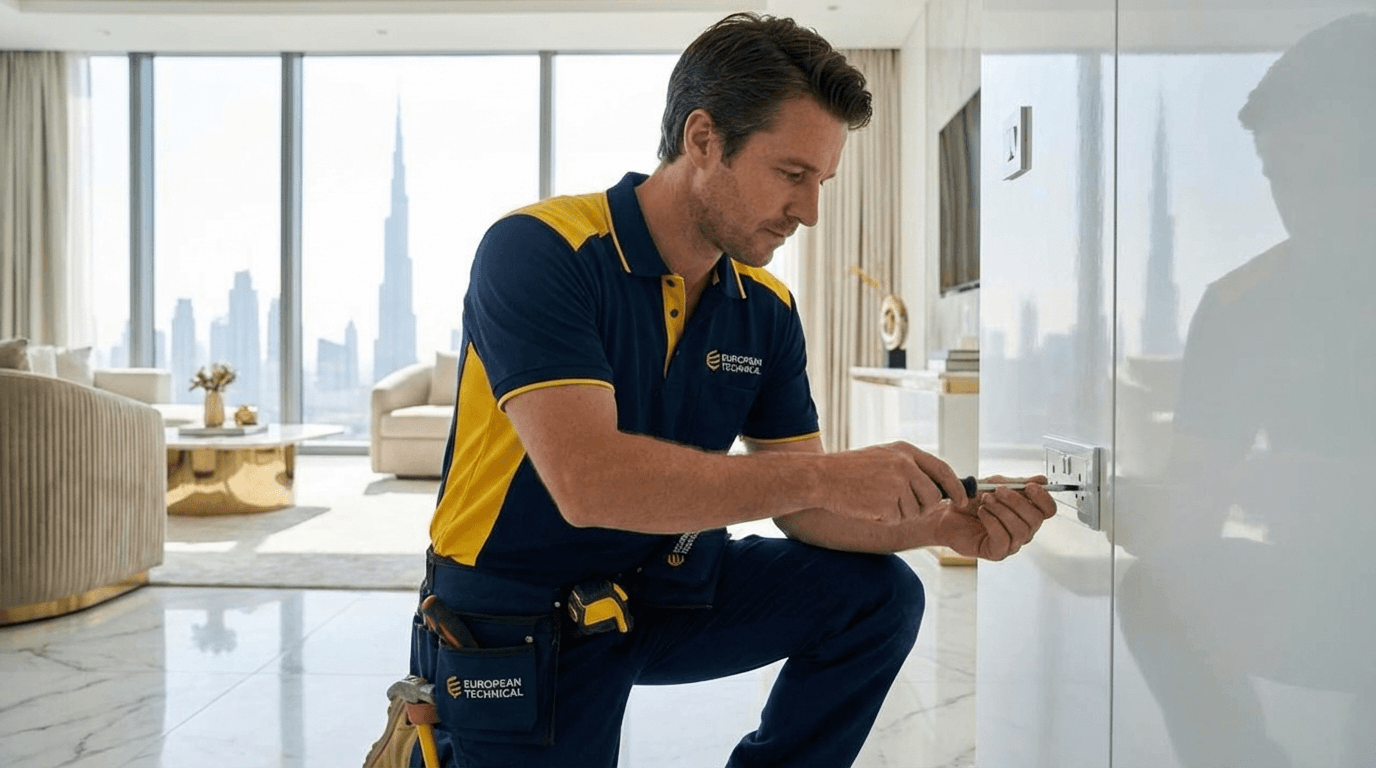
- Replacing or adding sockets and switches
- Installing new circuits or modifying existing wiring
- Any work in bathrooms (IP-rated installations)
- Outdoor and garden electrical installations
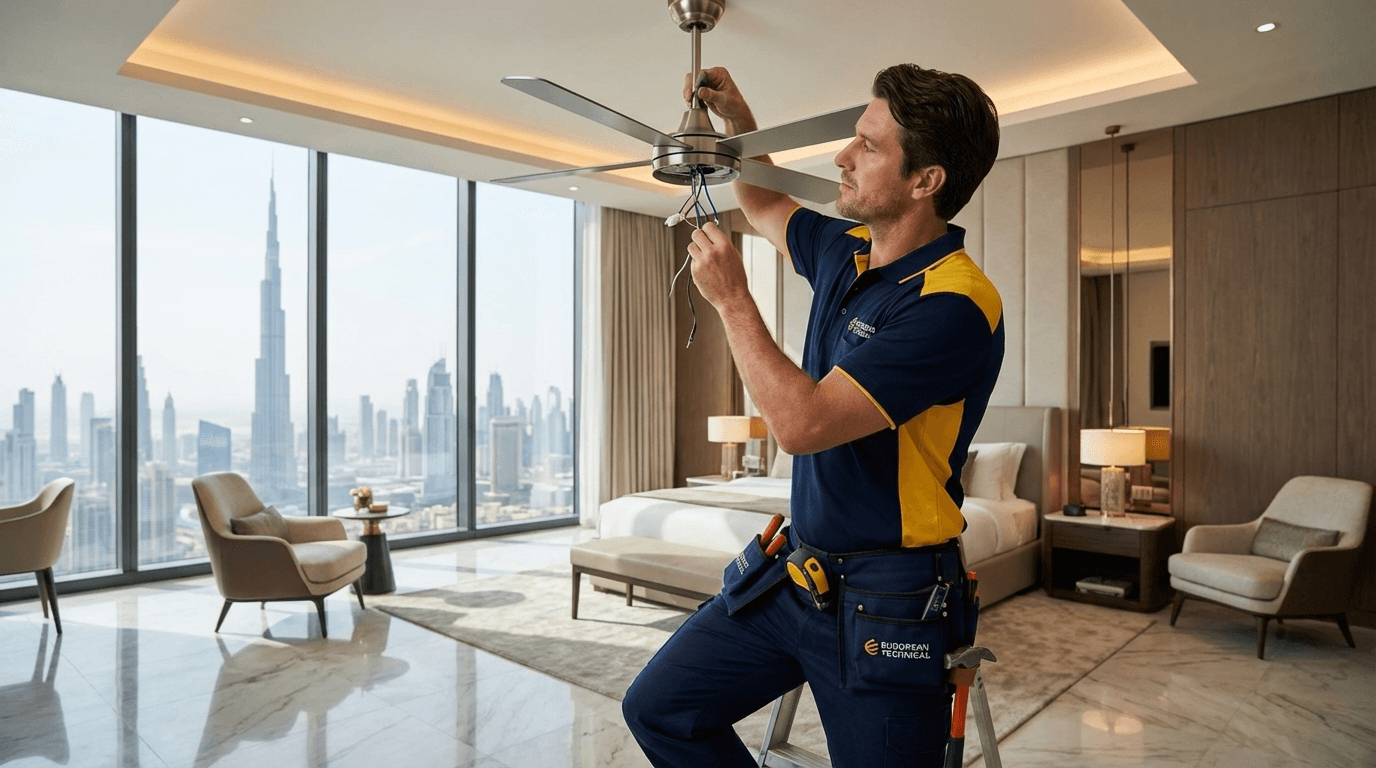
- Ceiling fan, chandelier, or fixed appliance installation
- Investigating repeated breaker trips or burning smells
- EV charger installation
Dubai Municipality and DEWA are clear on this: electrical work must be done by licensed professionals. The risk isn't just regulatory — electrical faults kill people and burn buildings. In 2024 alone, Dubai Civil Defence attended hundreds of fire incidents linked to electrical faults.
Book an Electrical Inspection
European Technical provides electrical safety inspections, repairs, and installations for apartments and villas across Dubai. Our electricians are DEWA-approved and Dubai Municipality licensed. We handle everything from a single socket replacement to full DB box upgrades and apartment rewiring.
Areas we cover: Dubai Marina, JBR, Downtown, Business Bay, Palm Jumeirah, JLT, DIFC, Al Barsha, Arabian Ranches, The Springs, Jumeirah Park, Dubai Hills, Motor City, Sports City, Deira, Bur Dubai, Discovery Gardens, and International City.
Call us on 04 234 6783 for an electrical inspection, repair, or installation quote. Licensed by Dubai Municipality.