Copy Your Parking Access Card in Dubai and Stop Overpaying the Landlord
Every resident and office tenant in Dubai knows the routine. You lose a parking access card, or you need a spare for a second driver, and the building management hands you a bill that feels wildly out of proportion to a small plastic card. The replacement fee is rarely about the card itself. It is an administrative charge, and building managers set it at whatever the market will bear.
There is a simpler, cheaper option that most people never consider: have the card copied. For the majority of residential towers and commercial buildings in Dubai, a parking or access card can be duplicated by a third party for a fraction of what the landlord charges, and it works exactly the same way at the barrier or the door.
This guide explains how these cards actually work, when copying is possible, what it typically costs versus an official replacement, and how to do it without falling foul of your building's rules.
How Dubai parking and access cards work
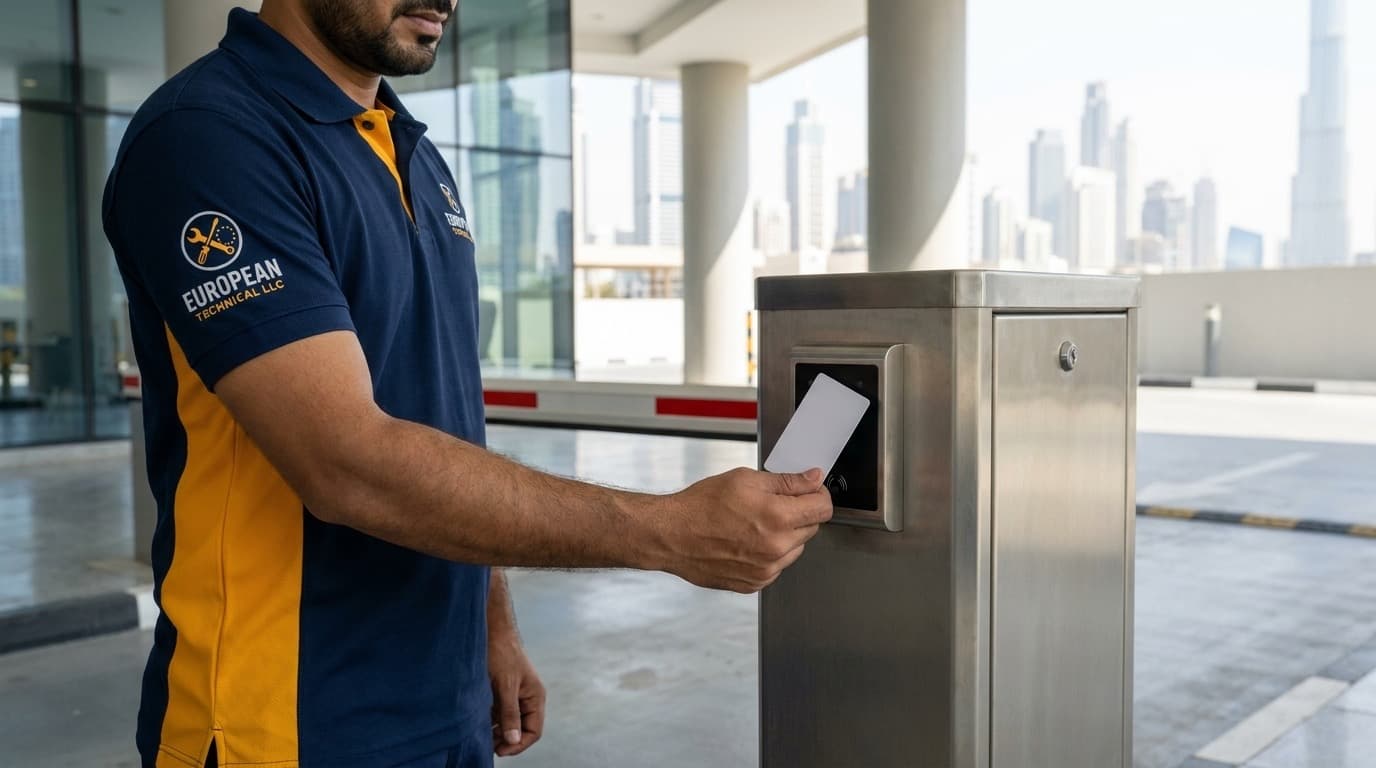
Almost every parking card, lobby fob, and office door pass in Dubai is an RFID card. RFID stands for radio frequency identification. The card has a tiny chip and an antenna built into the plastic. When you hold it near the reader at the barrier or the door, the reader sends out a small radio signal that powers the chip, and the chip sends back a number. The building's access system checks that number against its list of approved cards and either lifts the barrier or unlocks the door.
There is no battery in the card and nothing to charge. The whole exchange happens in a fraction of a second, which is why you can tap and drive through.
Two card technologies dominate the market here:
- 125 kHz proximity cards (often called EM cards). These are the older, simpler type. They broadcast a fixed identification number and nothing more. They are extremely common in older towers and many parking systems.
- 13.56 MHz smart cards (commonly MIFARE). These are newer and can hold more data. Some are still simple enough to copy, while others use encryption that makes duplication far harder.
You usually cannot tell which type you have just by looking. The card feels identical in your hand. A technician with the right reader can identify it in seconds, which is the first step in deciding whether a copy is possible.
Why landlords charge so much for a replacement
When you ask the building management for a new card, you are not paying for manufacturing. A blank RFID card costs the building only a few dirhams in bulk. What you are paying for is the building's policy, and those policies are written to discourage lost cards and to generate a tidy bit of revenue.
Replacement fees in Dubai vary enormously from one building to the next. Some towers charge a modest administrative fee. Others charge several hundred dirhams per card, and a few treat a second parking card as a premium add-on with its own monthly or annual cost. There is no central regulator setting these prices, so a tenant in one building can pay many times what a neighbour in the building next door pays for the identical service.
The frustrating part is that the building rarely needs to do anything technical to issue you a replacement. They take a blank card, add its number to their system, and hand it over. The cost to them is minutes of admin time. The cost to you is whatever figure appears on the invoice.
When copying your card makes sense
Copying is the practical alternative, and it suits several common situations:
- You need a spare. A household with two drivers but only one parking card is the classic case. Rather than renting a second card from the building at a recurring fee, you copy the one you already have.
- Your card is worn or cracked. Cards take a beating in wallets and car cup holders. A fresh copy onto a new blank restores reliable tapping without the building's replacement charge.
- You want a backup before you lose one. Making a copy while your card still works means you are never stranded at the barrier, and you never have to pay the building's lost-card penalty.
- You manage a property and rotate tenants. Landlords and property managers who handle several units can keep working spares ready instead of ordering new cards from the developer each time.
For a simple 125 kHz proximity card, duplication is quick and inexpensive. The technician reads the number off your existing card and writes it to a blank, and the copy is indistinguishable from the original as far as the barrier is concerned. A 13.56 MHz card may or may not be copyable depending on the exact type, which is why a quick check first saves time.
What copying typically costs versus the landlord
The headline reason to copy is money. A third-party copy of a standard proximity card is usually far cheaper than an official replacement from the building, often by a wide margin. Because building replacement fees range from modest to genuinely steep, the saving depends entirely on how aggressive your management company is with its pricing.
The honest position is this: get your building's replacement quote first, then compare it against a copy. In most towers with simple cards, the copy wins comfortably. Where a building uses an encrypted smart card that cannot be cloned, the official route may be your only option, and a good technician will tell you that straight away rather than waste your time.
There is also the convenience saving. A copy is done on the spot in a few minutes. An official replacement can mean a trip to the management office during working hours, a form, and a wait while they process it.
Can every card be copied?
No, and any technician who claims otherwise is overselling. The answer comes down to the card type.
Simple 125 kHz proximity cards and the most basic 13.56 MHz cards expose only a fixed number with no protection. These copy easily. The more advanced MIFARE cards use cryptographic keys, meaning the reader and card perform a secret handshake before the card reveals anything useful. Those cards resist casual duplication by design, and copying them is either impossible with standard equipment or requires the building's cooperation.
This is exactly why the first step is always to identify the card, not to promise a copy sight unseen. A proper assessment tells you in minutes whether your card is a candidate, and if it is not, you have lost nothing.
Staying within your building's rules
A sensible word of caution. Copying a card that belongs to you, for your own legitimate use as a resident or tenant, is a normal convenience service. But buildings do set their own rules, and some tenancy agreements or community guidelines restrict how many access credentials a unit may hold or require that all cards be issued through management.
Before you copy, it is worth a quick check of your tenancy terms or a word with your building manager, particularly in gated communities and higher-end towers. The goal is a working spare without a dispute later. A reputable technician will only ever copy a card you already own and present yourself; nobody should be duplicating a card that is not yours.
How European Technical handles it
We carry the readers and blank cards for the common Dubai card types, so we can identify your card and tell you immediately whether a copy is possible. If it is, the duplicate is made on the spot and tested before you leave. If your building uses an encrypted card that cannot be cloned, we will say so plainly rather than sell you something that will not work.
Parking and access cards sit alongside the wider set of access, electrical, and general maintenance work we do. If you are dealing with locks as well as cards, our emergency locksmith service in Dubai covers lockouts and lock changes, and our key cutting service handles spare keys for the same household that needs a spare parking card. Access systems are often wired into a building's electrical supply, so our electrician service in Dubai handles the reader and intercom side, while our handyman service takes care of the small fitting and mounting jobs that come with it. For background, see our guide to access card duplication in Dubai.
Many of our clients fold small jobs like this into a single maintenance relationship rather than calling around for one-off tasks. Our annual maintenance contract bundles the routine work a home or office needs across the year, so a spare card, a sticking lock, or a flickering light gets handled by one trusted team instead of a different stranger each time.
Frequently asked questions
Is it legal to copy my own parking access card in Dubai?
Copying a card that belongs to you, for your own use as the resident or tenant, is a standard convenience service. What matters is your building's policy. Some tenancy agreements or community rules limit how many access cards a unit can hold or require cards to be issued through management. Check your terms or ask your building manager if you are unsure, especially in gated communities.
How much does it cost to copy a parking card compared with the landlord's replacement?
A third-party copy of a standard proximity card is usually far cheaper than an official building replacement, often by a wide margin. Building replacement fees in Dubai range from modest to several hundred dirhams, with no central regulator setting the price. Get your building's quote first, then compare; in most towers with simple cards, the copy is the cheaper choice.
Can all access cards be copied?
No. Simple 125 kHz proximity cards and basic 13.56 MHz cards copy easily because they only broadcast a fixed number. Advanced MIFARE smart cards use encryption and resist duplication by design. The only way to know your card's type is to have it read, which takes a couple of minutes.
Will a copied card work exactly like the original at the barrier?
For copyable card types, yes. The duplicate carries the same number the reader is looking for, so the barrier or door treats it identically to the original. A good technician tests the copy before you leave.
Can you copy a card if I have lost it?
No. Copying requires the original card to read its number. If the card is already lost, you will need the building to issue a replacement. This is exactly why making a spare while your card still works is the smarter move.
Do you copy office and commercial building cards too?
Yes, the same principles apply to office door passes and commercial parking cards. We identify the card type first and confirm whether it can be duplicated before doing any work.
The bottom line
A parking or access card is a few dirhams of plastic and a number. The fee your building charges to replace it has little to do with either. For most Dubai towers using standard proximity cards, copying the card you already own is faster, cheaper, and just as reliable as paying the landlord's replacement price. The sensible approach is to have your card identified, confirm a copy is possible, make a spare before you ever lose one, and keep a quick eye on your building's rules along the way.