Dubai has one of the highest rates of CCTV adoption in the world, and with good reason. Protecting a villa in Jumeirah, a retail unit in Deira, or a warehouse in Al Quoz, a properly installed camera system provides genuine security and, in the event of an incident, footage that holds real evidentiary value.
The problem is that the market in Dubai is saturated with CCTV installation companies ranging from highly professional to frankly unreliable. This guide covers how to evaluate CCTV companies in Dubai, what a quality installation looks like, what you should expect to pay, and what to avoid.
What CCTV Installation Actually Involves
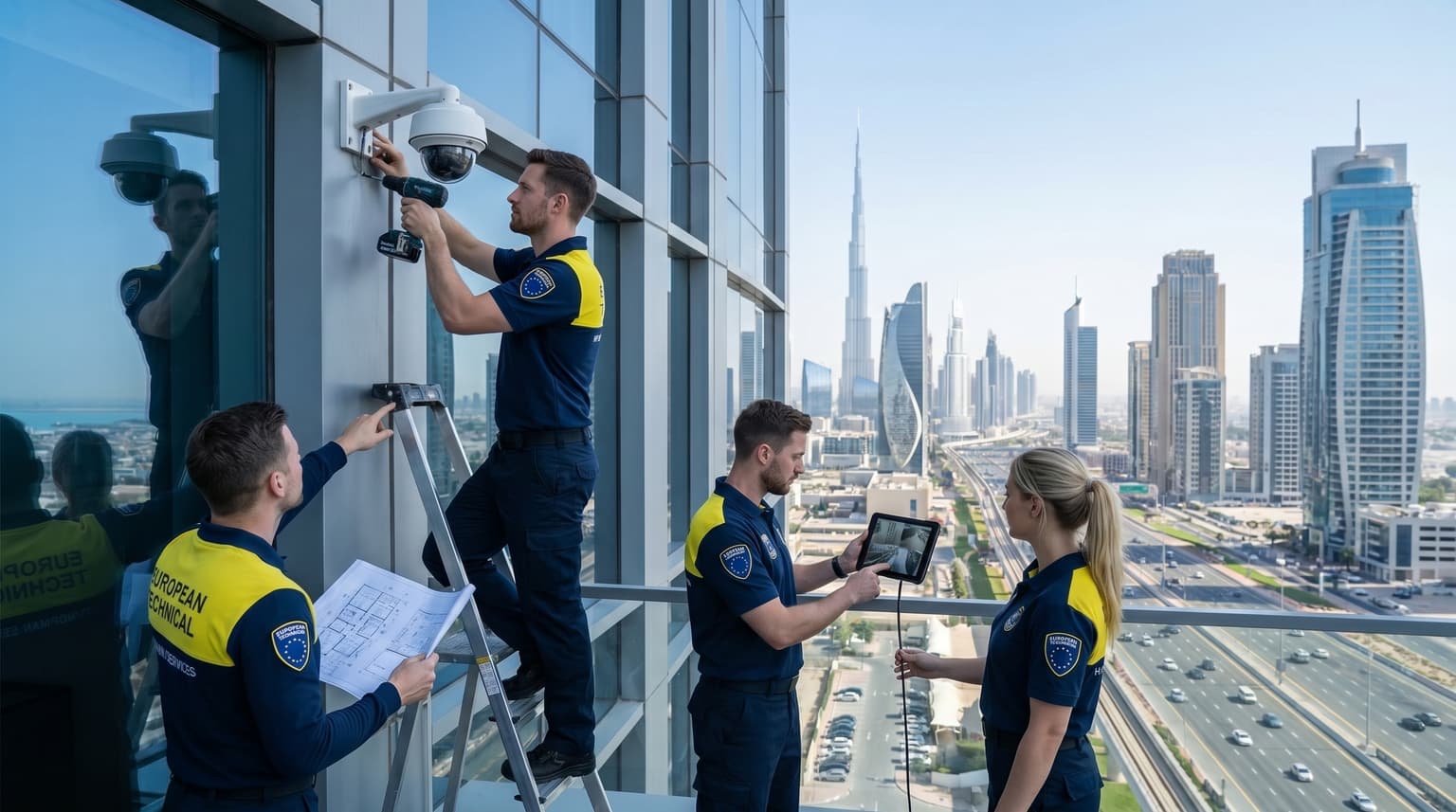
A professional CCTV installation is not just running cable and mounting cameras. Done properly, it involves:
- Site survey and camera placement planning: identifying blind spots, optimal camera angles, lighting conditions, and cable routing
- Camera selection: matching camera specifications to the environment (indoor vs outdoor, day/night, resolution, field of view)
- Cable installation: either concealed within walls and ceilings or neatly trunked for commercial properties
- DVR/NVR setup: configuring the recording unit, setting storage schedules, and calibrating motion detection
- Remote access configuration: setting up secure mobile viewing so you can monitor your property from anywhere
- Testing and handover: confirming all cameras are recording correctly, demonstrating the system, and providing documentation
Any company that quotes without visiting your property first, or installs cameras without explaining camera placement decisions, is cutting corners.
Types of CCTV Systems Available in Dubai
Analogue CCTV (DVR-based)
The older standard, still widely installed. Uses coaxial cables connected to a Digital Video Recorder. Reliable and cost-effective for straightforward applications, but image quality tops out at around 1080p and the cable infrastructure is less flexible than IP systems.
Suitable for: Small retail units, basic home monitoring, budget-conscious projects.
IP CCTV (NVR-based)
The current standard for professional installations. Cameras connect over network cables (Cat5e/Cat6) or Wi-Fi to a Network Video Recorder. Supports resolutions up to 4K, advanced analytics (person detection, licence plate recognition), and easier remote access.
Suitable for: Villas, offices, multi-camera residential setups, anywhere high-definition footage matters.
Wireless / Wi-Fi CCTV
Cameras connect to the network wirelessly. Simpler to install but dependent on Wi-Fi signal strength and more vulnerable to interference and hacking if not secured properly.
Suitable for: Rental properties where cabling is impractical, temporary installations, indoor monitoring with a reliable Wi-Fi network.
PTZ (Pan-Tilt-Zoom) Cameras
Motorised cameras that can be directed to specific areas and zoomed in remotely. Used in larger sites, car parks, and commercial properties where manual reorientation would be impractical.
CCTV Installation Prices in Dubai: What to Expect in 2026
Pricing varies substantially based on system type, number of cameras, cabling complexity, and the quality of equipment used. Here are realistic ranges:
| System | Price Range (AED) |
|---|---|
| 2-camera basic home system (analogue, installed) | AED 1,200 , 2,000 |
| 4-camera IP system for villa or apartment | AED 2,500 , 4,500 |
| 6-camera IP system for villa with remote access | AED 4,000 , 7,000 |
| 8-camera system for retail or office | AED 5,000 , 10,000 |
| 16-camera system for warehouse or large premises | AED 10,000 , 20,000+ |
These prices include equipment and installation. Watch out for quotes that seem unusually low, as they often involve cameras with poor low-light performance, limited warranty coverage, or installation that doesn't include proper cabling.
How to Evaluate CCTV Installation Companies in Dubai
1. cheque for Proper Licensing
CCTV installation companies in Dubai should hold a Dubai Economy and Tourism (DET) trade licence and, for security-related services, be registered with the Dubai Police or relevant authority. Ask for licence details before signing any agreement.
2. Ask for a Site Survey
Any reputable company will visit your property before providing a final quote. A quote given over the phone or via WhatsApp without seeing the property cannot account for cable routing, power availability, or actual camera placement needs.
3. Verify Equipment Brands
The cameras and recording equipment matter significantly. Ask specifically what brand and model will be installed. Reputable brands used by professional installers include Hikvision, Dahua, Axis, and Hanwha. Be wary of unbranded or no-name equipment sold under vague product names.
4. Clarify Warranty Terms
Equipment warranties in Dubai typically run 1, 2 years for cameras and recorders. cheque whether the warranty is with the installer or directly with the manufacturer, and whether labour is covered for warranty repairs.
5. cheque What Remote Access Looks Like
A quality installer will configure your system for secure remote viewing on your mobile and provide you with login credentials and instructions at handover. If remote access is an afterthought or "optional extra," that's a gap in the service.
6. Read Their Contract
Before any work starts, you should receive a written scope of work, equipment list, installation date, payment terms, and warranty terms. Verbal agreements are not sufficient for a purchase of this size.
CCTV Requirements Under Dubai Regulations
Dubai Municipality and Dubai Police have specific guidelines for CCTV systems in certain types of properties. For commercial premises and retail units, there are minimum requirements around camera placement, resolution, and storage duration that must be met to comply with licensing and permit conditions.
If you're installing CCTV in a residential building with shared areas, cheque with your building management regarding any requirements under the strata or building rules.
Common CCTV Installation Mistakes to Avoid
Positioning cameras too high. A camera mounted at 4, 5 metres captures the tops of heads and little else. For facial identification, cameras should be positioned at 2.5, 3.5 metres.
Inadequate lighting coverage. Most cameras perform significantly worse in low light, even those marketed as "night vision." Ensure cameras covering entry points have adequate external lighting or specify cameras with proper infrared or full-colour night vision.
Insufficient storage. Standard systems record on a loop and overwrite older footage. For most security purposes, 30 days of storage is a minimum. Calculate how many cameras you have, the resolution, and the recording schedule before specifying storage.
No remote access testing at handover. Always test remote viewing from your mobile phone on both the local network and mobile data before the installer leaves. Issues discovered after they're gone take longer to resolve.
Single point of failure. If all cameras feed to a single recorder placed in an obvious location, a theft that targets the recorder loses all footage. Ask about cloud backup options or secondary storage.
When to Call European Technical
European Technical installs and maintains CCTV systems across Dubai for residential, commercial, and industrial clients. Our installations use professional-grade equipment, include a full site survey, and come with proper documentation and remote access setup.
We cover all areas including Jumeirah, JVC, Business Bay, Dubai Marina, Al Barsha, Arabian Ranches, Mirdif, and Palm Jumeirah.
Contact us: - Phone: 800 031 10015 - WhatsApp: https://wa.me/971800311015 - Book a consultation: https://europeantechnical.ae/book
See also: Smart Home Systems | Electrical Services
Frequently Asked Questions
Do I need permission to install CCTV in my villa or apartment in Dubai?
For private residential use on your own property, no special permit is required. However, cameras must not capture public spaces, neighbouring properties, or communal building areas without appropriate authorisation. For commercial premises, cheque your operating licence requirements with the relevant authority.
How long is CCTV footage stored in Dubai?
There is no single legal minimum for residential use, but 30 days is the practical standard for most installations. Commercial properties subject to Dubai Police or Municipality requirements may need longer retention periods. cheque the specific requirements for your licence category.
Can CCTV cameras work during power cuts?
Standard cameras and recorders lose power during an outage. If continuous recording during power cuts is required, specify a UPS (Uninterruptible Power Supply) at the time of installation. This is worth doing for any security-critical camera points such as main entrances.
What's the difference between DVR and NVR systems?
A DVR (Digital Video Recorder) connects to analogue cameras via coaxial cable. An NVR (Network Video Recorder) connects to IP cameras via network cables or Wi-Fi. NVR systems offer higher resolution, more flexibility, and better remote access. They are the current standard for new installations.
How often does CCTV equipment need maintenance?
Professional CCTV systems require minimal maintenance beyond occasional lens cleaning and software/firmware updates. An annual cheque by a technician to verify recording schedules, storage health, and remote access functionality is recommended.
Making the Right Choice
CCTV installation in Dubai is a straightforward purchase if you approach it correctly: get a site survey, verify the equipment being installed, cheque licensing, and get everything in writing. The difference between a system that provides genuine security and one that fails when you need it most often comes down to the quality of the installation, not the cameras themselves.
Get a CCTV installation quote from European Technical or call 800 031 10015.
Published by European Technical Team