Why Your Apartment AC Needs More Attention Than You Think
Living in Dubai means your air conditioner is not a seasonal luxury. It runs for eight to ten months of the year, and during June, July and August it barely switches off at all. Whether you are in a tower in Dubai Marina, a studio in JVC or a larger apartment in Business Bay, your AC works harder than units in almost any other city on earth.
That constant workload, combined with fine desert dust and high coastal humidity, means your system collects debris and wears down components faster than you might expect. The good news is that a small amount of routine attention keeps cooling performance high, keeps your DEWA bill somewhat in check and dramatically reduces the chance of a breakdown in the middle of August, when every technician in the city is fully booked.
This guide covers the practical essentials: how often to service, what you can check yourself, what a service should cost in dirhams, who is responsible for AC in an apartment building, and the warning signs that tell you to call a professional before a minor fault becomes a major repair. For anything beyond basic upkeep, our ac maintenance team handles apartments across Dubai every day of the week.
How Often Should You Service Your AC in Dubai?
The short answer: more often than in cooler climates. As a reliable guide:
- Air filters: clean or replace every three months
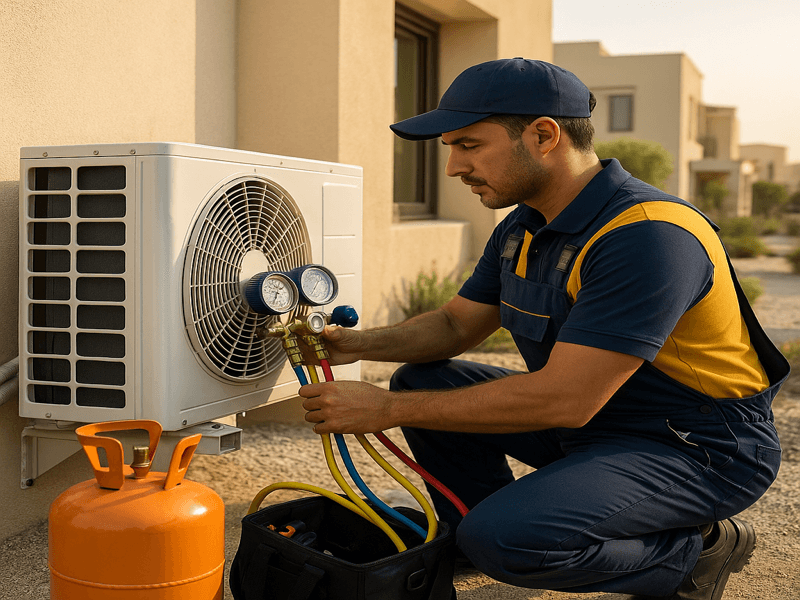
- Full service of coils, drain lines and refrigerant checks: every three to six months
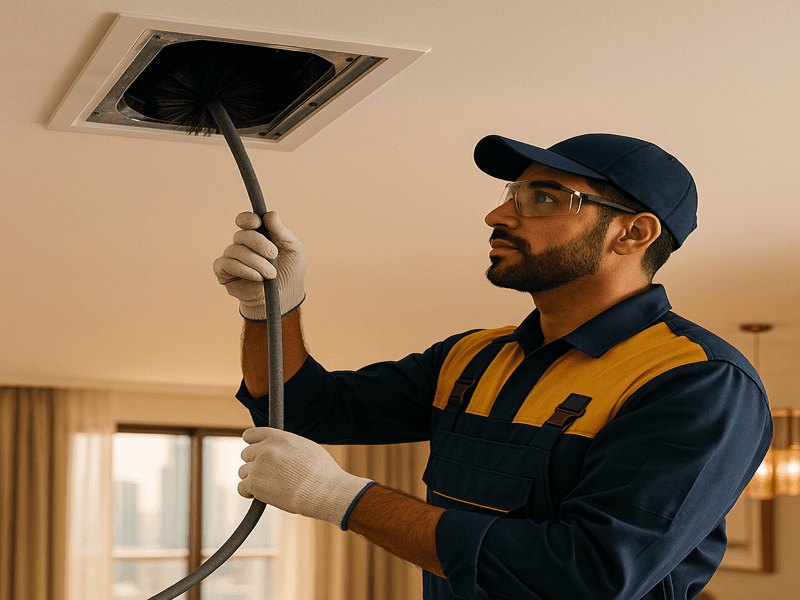
- Ducted systems: a full duct clean once a year
Homes near the coast, such as apartments in Dubai Marina or JBR, or properties in dustier inland areas, often need servicing at the shorter end of that range. The same applies if your unit runs almost continuously over summer or if you have pets, as fur and dander clog filters surprisingly quickly.
Timing matters too. Pre-summer servicing, booked in April or May before the heat peaks, is crucial for efficiency. A unit that has been cleaned and checked in spring enters the toughest months of the year in peak condition. Book the same service in July and you may wait days for an available slot while your living room sits at 30 degrees.
One point worth repeating: even units in rarely used rooms, such as a guest bedroom, should be serviced. Dust settles in idle units, and the first time you switch a neglected unit on it can blow that accumulation straight into the room or trip a fault. Service all the units in your apartment, not just the busy ones.
Simple Checks and Cleaning You Can Do Yourself
You do not need to be an engineer to keep on top of the basics. Ten minutes every few weeks makes a genuine difference.
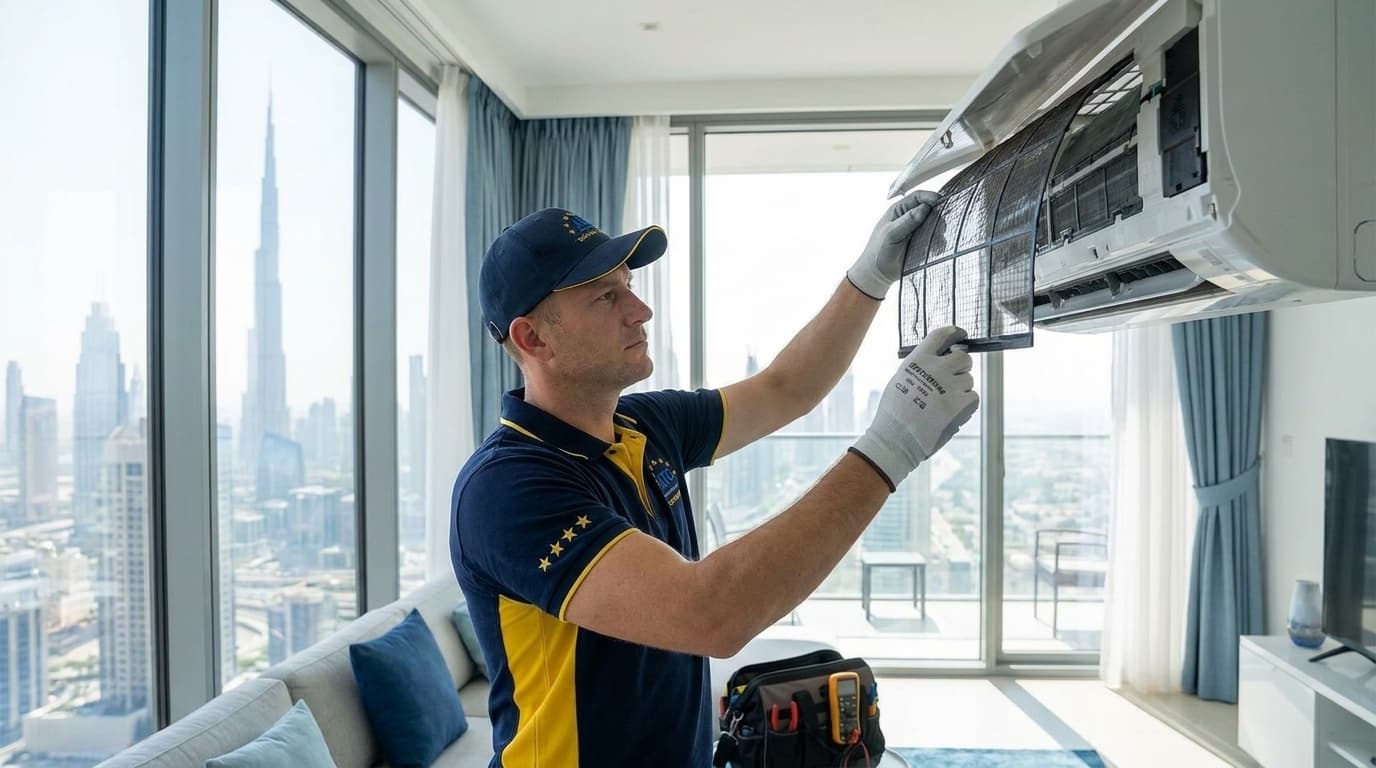
Clean or Replace the Filters Every Three Months
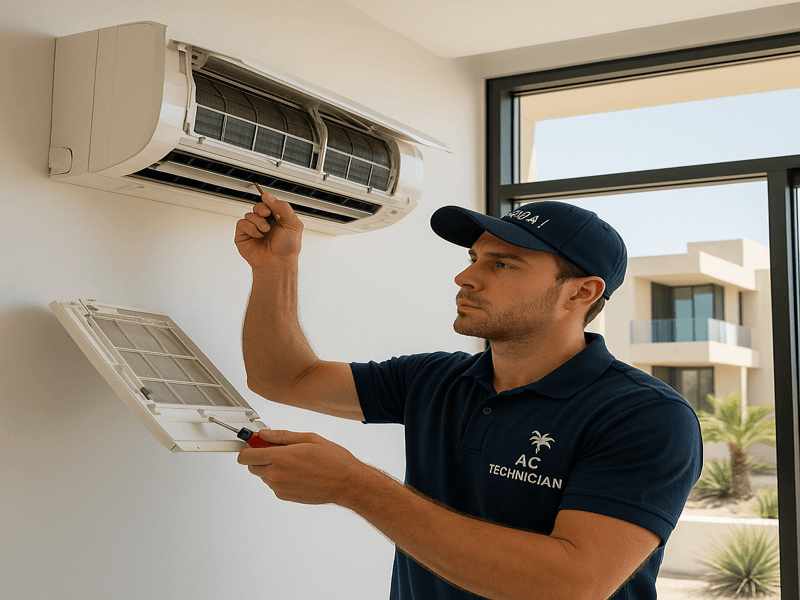
This is the single most useful task an apartment resident can perform. On most split units found in Dubai apartments, including Daikin, O'General, Mitsubishi, LG, Samsung, Gree, Midea and Super General, the front panel lifts up from the bottom. Grip both sides gently and lift upward until it clicks open. Slide the filters out, vacuum off the dust or rinse them under running water, let them dry fully, then slide them back in.
Clogged filters restrict airflow, force the compressor to work harder and push up your electricity consumption. If the filter is damaged or has become permanently discoloured, replace it rather than washing it.
Inspect Coils, Insulation and Vents
While the panel is open, look for visible damage to the coils or the insulation on the copper refrigerant pipes. Torn or degraded insulation reduces cooling efficiency and can cause condensation dripping. Check that all vents are fully open and that furniture, curtains or stored boxes are not blocking airflow around the indoor unit. A sofa pushed against a wall-mounted unit can choke its intake and undermine the whole system.
Keep the Outdoor Unit Clear
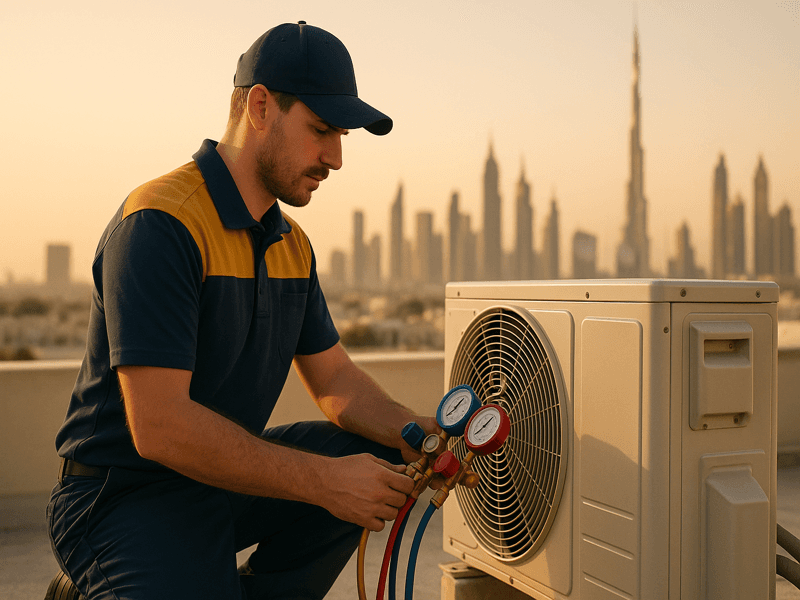
If your apartment has an accessible outdoor condenser on a balcony or ledge, make sure leaves, dust and debris are not packed against the coil fins. Gently rinsing the outdoor coil a few times a year helps heat dissipate properly, which is exactly what you want when the outside temperature is pushing 45 degrees.
Clear a Blocked Condensate Drain Line
A dripping indoor unit is very often a blocked condensate drain rather than a serious fault, and you can usually clear it yourself. Two methods work well:
Vacuum method. If you have a wet/dry vacuum, place the nozzle over the open end of the drain pipe, the end outside your apartment, and switch it on. The suction often pulls the blockage out in seconds.
Vinegar flush. Pour half a cup of plain white vinegar into the drain pipe from the indoor side, where it connects to the AC unit. Let it sit for 30 minutes. The vinegar dissolves algae and slime buildup. Then flush with clean water.
If dripping continues after both methods, stop there and call a technician, as the pan or pipe may need professional attention.
What AC Servicing Costs in Dubai
For budgeting purposes, minor AC servicing in Dubai normally costs around 179 AED per unit. This typically covers filter cleaning, coil cleaning, drain flushing and a general performance check.
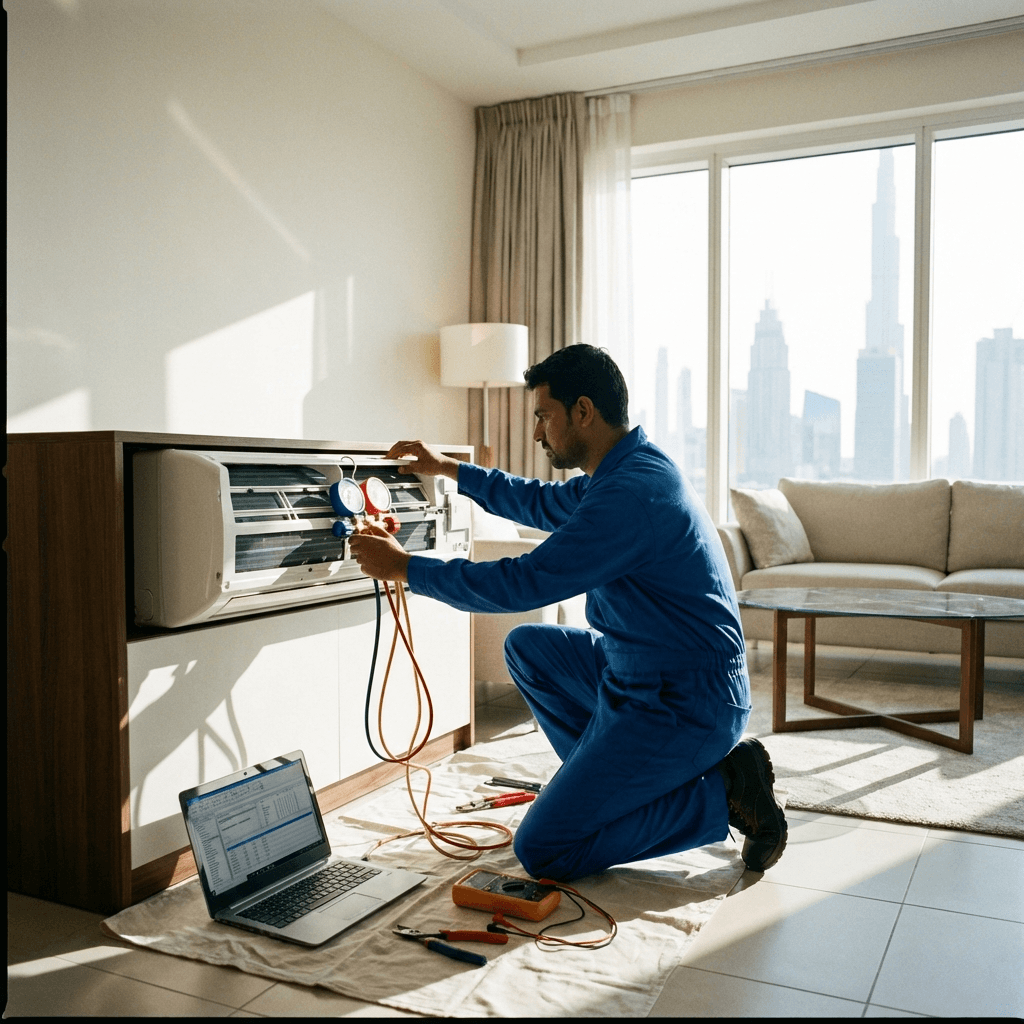
Major AC maintenance is a different matter. Deep cleaning of evaporator coils, gas top-ups, duct cleaning and repairs depend on the size, type and make of the unit, so costs vary considerably. A split unit in a one-bedroom apartment is a very different job from a ducted system serving a three-bedroom in Arabian Ranches. Residents commonly report paying roughly 800 to 1,000 AED for a more intensive single-unit service, particularly when chemical cleaning of the coil and fan blower is due, and the difference in performance afterwards is immediately noticeable.
The honest advice: do not wait for quotes to become urgent. Ask for pricing while the weather is mild, and consider bundling all your apartment's units into one visit, which usually works out cheaper per unit than separate call-outs.
If you own the property or look after several units, an annual maintenance contract removes the guesswork entirely. Scheduled visits, priority response and a fixed annual cost mean you never have to remember when the last service was, and you skip the summer rush altogether.
Apartment AC: Whose Responsibility Is It Anyway?
This confuses a lot of residents, so let us be clear. In most Dubai apartment buildings, the AC units serving your individual apartment must be serviced separately from the building's central chilled water or common systems, and arranging that servicing is your responsibility as the tenant or owner. The building's service charges generally cover common areas and central plant, not the split units inside your flat or the ducts serving your rooms.
Ducts within your apartment should also be cleaned regularly, ideally once a year, because dust and mould buildup inside ductwork affects air quality as much as cooling performance.
If you are unsure where the boundary sits in your building, ask your building management or landlord before assuming. Discovering that a broken unit is your responsibility only after it fails, in August, with a three-week waiting list, is an unpleasant surprise. And if the problem turns out to be a genuine fault rather than a maintenance gap, our ac repair team can diagnose it quickly and give you a straight answer on what needs fixing.
Warning Signs You Should Not Ignore
Regular servicing prevents small issues from becoming major malfunctions, but units still develop faults between visits. Catch these early:
- Weak airflow or warm air despite correct settings, often a clogged filter, dirty coil or refrigerant issue
- Water dripping from the indoor unit, usually a blocked drain line or damaged pan
- Unusual smells, particularly musty odours, which point to mould in the filter, coil or ducting
- Strange noises such as grinding, rattling or hissing, which can indicate fan or refrigerant problems
- Rising DEWA consumption with no change in usage habits, a classic sign of an inefficient, strained system
- The unit short-cycles, switching on and off frequently without reaching the set temperature
Any of these warrants a professional inspection. A technician can determine during a routine visit whether more frequent servicing is needed, and preventive maintenance catches potential problems while they are still cheap to fix. A failed compressor is one of the most expensive repairs in air conditioning; a coil cleaning at your next service is not.
Why Regular Maintenance Pays for Itself
Think of servicing as insurance with a positive return. A clean filter, clear drain and healthy coils mean the system cools the apartment faster, uses less electricity to hold temperature, and is far less likely to fail when you need it most. Residents who keep to a three to six month schedule consistently report cooler rooms, fresher-smelling air and lower summer bills than neighbours who only call when something breaks.
There is also the matter of air quality. Dubai apartments are sealed for most of the year, so every breath you take indoors passes through that filter and coil. Keeping them clean is not just about temperature.
Our team at European Technical provides AC servicing, repair and full maintenance contracts across Dubai, from Marina towers to JVC low-rises and villas in Arabian Ranches. If it has been more than six months since your last service, now is the moment to book, ideally before the summer heat arrives. For more on what a visit involves, see our AC services overview.
FAQ
How often should I service my AC in Dubai?
Because AC in Dubai runs for eight to ten months a year, it needs more frequent servicing than in cooler climates. Clean or replace filters every three months, have the coils and a deeper service carried out every three to six months, and schedule a full duct service once a year. Homes near the coast, in dusty areas, or with heavy use often need servicing more often.
How much does AC servicing cost in Dubai?
Minor AC servicing normally costs around 179 AED per unit, covering filters, coils and a general check. Major maintenance, such as chemical coil cleaning or repairs, depends on the size and make of the unit, and residents commonly report around 800 to 1,000 AED for an intensive single-unit service. Always request a quote for major work before proceeding.
In an apartment, is the AC centralised or do I need to arrange my own servicing?
In most cases, the AC units serving your apartment must be serviced separately from the building's central system, and arranging this is your responsibility. You should also ensure ducts within your apartment are cleaned regularly. If you are not sure, speak to your building management to confirm whether you need to schedule AC servicing yourself.
Do I need to service units in rooms I rarely use?
Yes. Even units in a guest room that is used occasionally should be serviced on the same schedule. Dust accumulates in idle units, and switching on a neglected unit can circulate that dust into the room or trigger a fault. Include every unit in the property in your servicing plan.
Why is pre-summer AC servicing so important?
Pre-summer servicing, ideally in April or May, is crucial for efficiency. Your AC faces its heaviest workload from June to August, and a cleaned, checked unit enters that period in peak condition while using less energy. Booking before the heat also means shorter waiting times, since demand for technicians surges once temperatures climb.
Can I clear a dripping AC drain line myself?
Often, yes. Use a wet/dry vacuum on the external end of the drain pipe to suck out the blockage, or pour half a cup of white vinegar into the pipe from the indoor side, leave it for 30 minutes to dissolve algae and slime, then flush with clean water. If the dripping continues after both methods, call a professional to inspect the drain pan and pipework.