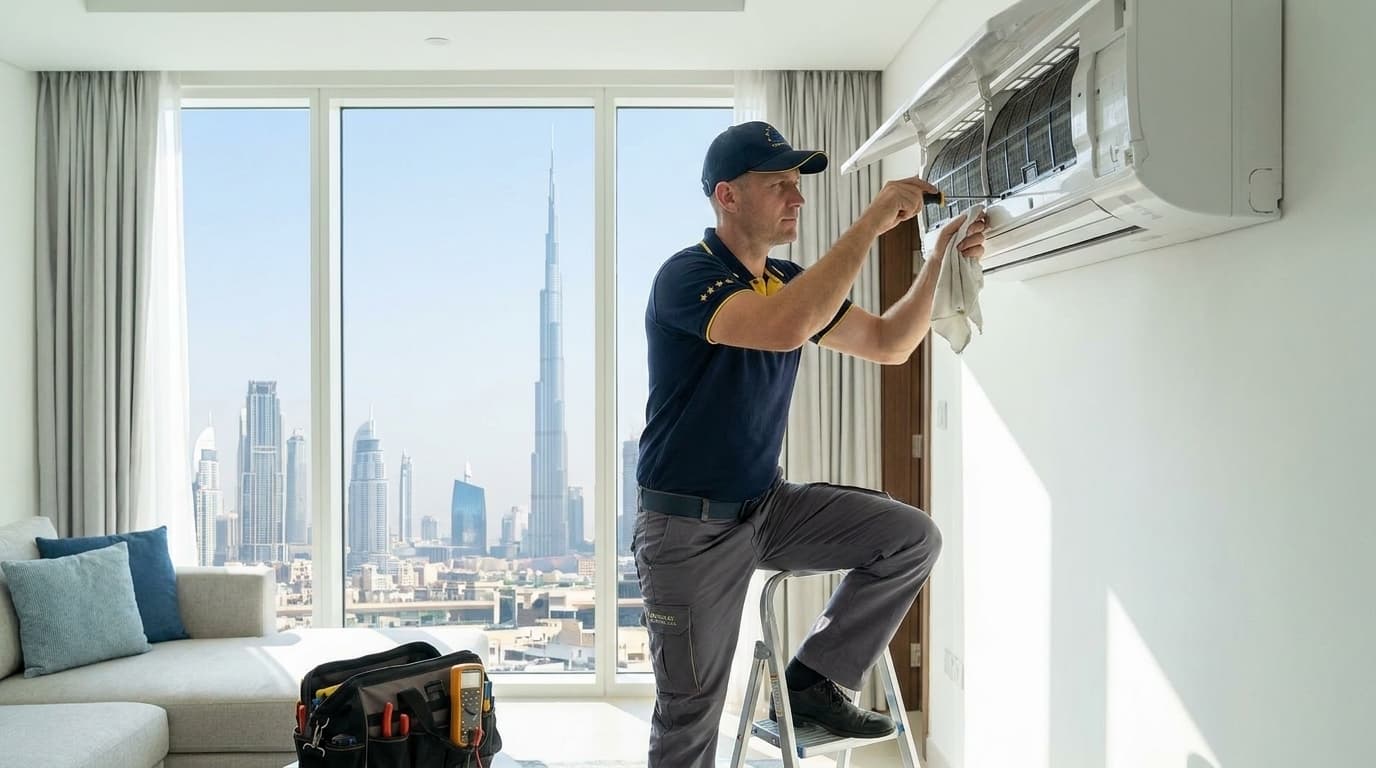
Why AC Servicing Matters More in a Dubai Apartment Than Almost Anywhere Else
If you live in a Dubai apartment, whether it is a studio in JVC, a one-bedroom in Business Bay, or a larger unit in Dubai Marina, your air conditioning is not a seasonal luxury. It is the one system your home cannot function without. AC in Dubai typically runs for eight to ten months of the year, and during the peak of summer it may hardly switch off at all. That level of use means your units collect dust, wear components faster and lose efficiency far more quickly than an equivalent system in a cooler climate.
The good news is that a modest servicing routine keeps almost all of the common problems at bay. The most frequent AC faults we see in Dubai apartments are refrigerant leaks, water dripping from the indoor unit, capacitor failures, blocked drain lines and compressor faults. Every one of these is accelerated by heat, dust and the sheer cooling load placed on apartment units during the long summer. Regular servicing catches them early, when a repair is cheap, rather than in August at midnight when it is urgent.
There is a financial angle too. A dirty filter or clogged coil forces the unit to work harder, which shows up directly on your DEWA bill. Clean units cool better, use less electricity, last longer and do a far better job of filtering the fine dust that settles over everything in Dubai. If you own the apartment and rent it out, a well-maintained AC system also means fewer emergency calls from tenants.
How Often Should You Service Your AC in Dubai?
The general guidance for Dubai homes is to service the AC every three to six months, with filters checked monthly. Here is a practical cadence that works for most apartments:
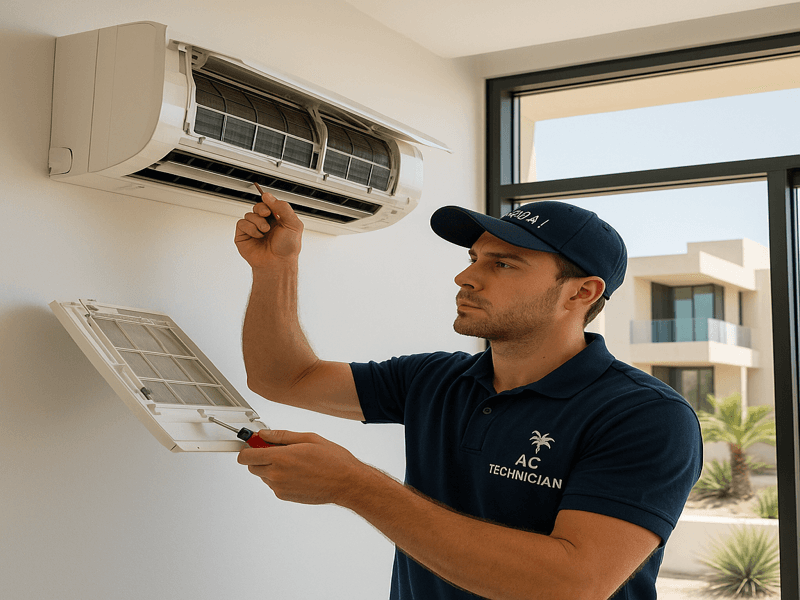
Monthly: Check the filters yourself. Pop open the indoor unit's front panel, slide out the filter and hold it up to the light. If you can see a mat of grey dust, rinse it under the tap, let it dry fully and slide it back in. In dusty areas or during sandstorm season, filters can clog within weeks. This single habit does more for your cooling and your electricity bill than anything else you can do yourself.
Every three months: Clean or replace filters professionally as part of a standard service. Split AC servicing in Dubai typically costs around AED 150 per unit, with central AC at roughly AED 200 per unit and package units around AED 500, so a two-bedroom apartment with three or four split units is a manageable, predictable expense.
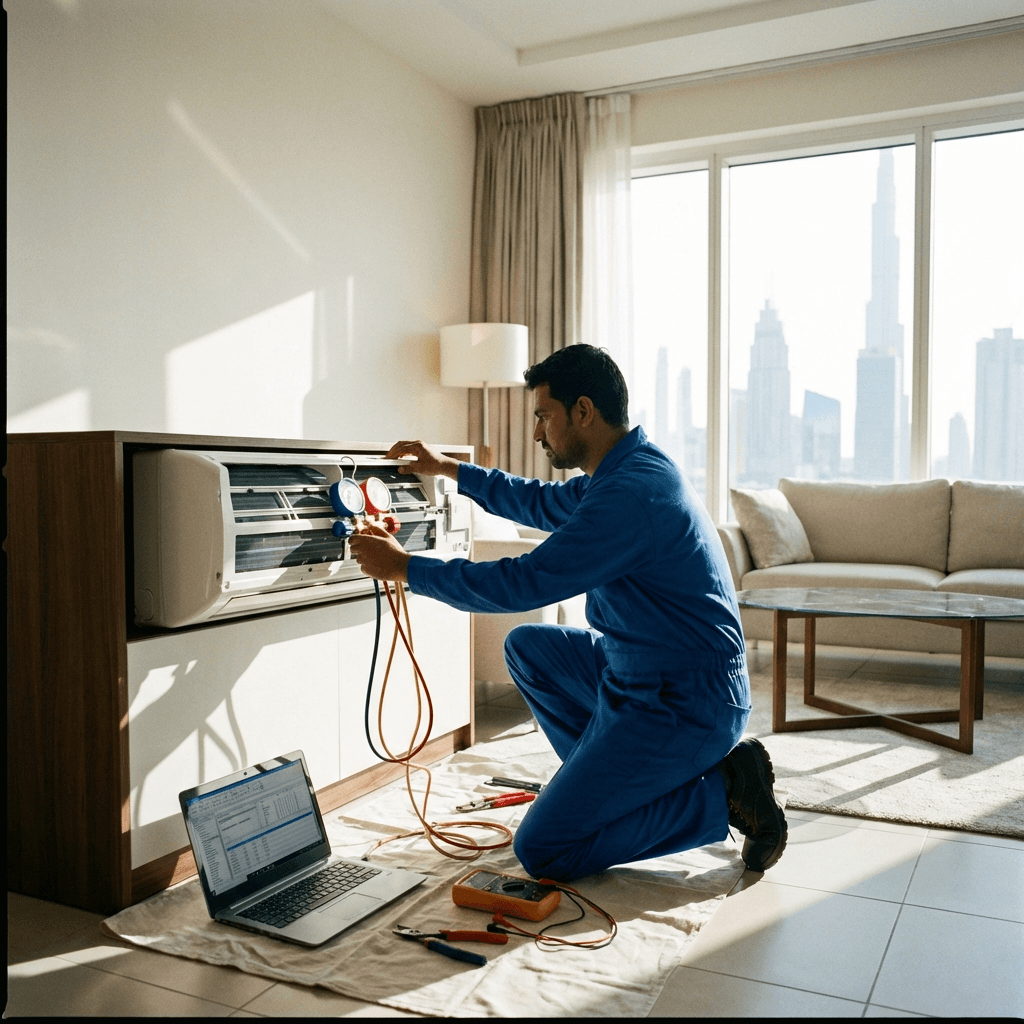
Every three to six months: Have a technician carry out a deeper service covering coil cleaning, drain line flushing, a thermostat check, a gas pressure check, an electrical inspection and performance testing. This is the visit that prevents water leaks and compressor faults.
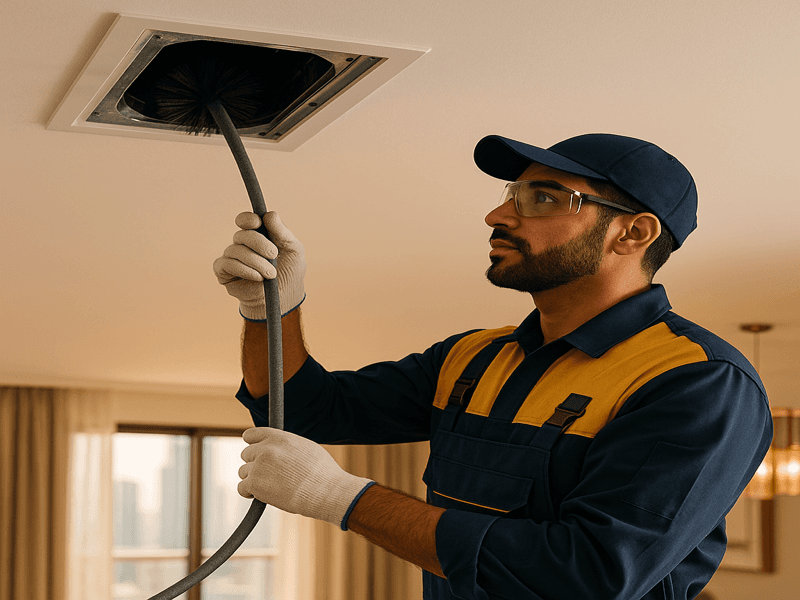
Once a year: Book a full duct service if your apartment has internal ductwork. Ducts accumulate dust and contamination over time, and cleaning them noticeably improves air quality, which matters if anyone in the household has allergies or asthma.
Homes near the coast, such as those in Dubai Marina, JBR or Palm Jumeirah, often need servicing more often because salt-laden air corrodes coils faster. The same applies to apartments in dusty pockets near construction sites, and to homes where the AC runs almost constantly. Pre-summer servicing is strongly recommended: book for April or early May, before the first heatwave, so you are not competing with everyone else for an engineer in June.
Apartment Versus Centralised AC: What Are You Actually Responsible For?
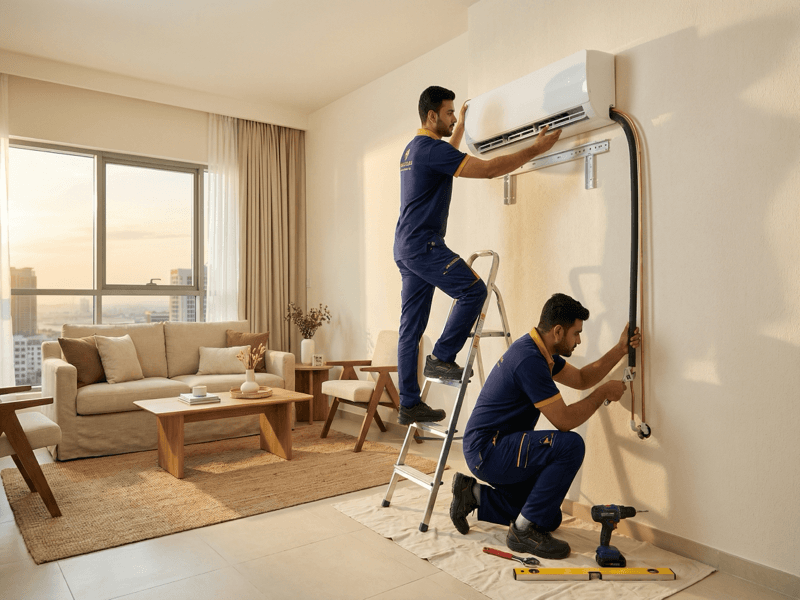
This confuses a lot of new residents, and it is worth clarifying before you assume the building has it covered. In most Dubai apartment buildings, the AC units serving your individual apartment need to be serviced separately from the building's central plant, and arranging that service is usually your responsibility, whether you own or rent. In practice, this means the split units or fan coil units inside your apartment, and the ducts running within your apartment, are yours to maintain.
If you are not sure how your building is set up, speak to your building management or the owner's representative. Some towers in Downtown, Business Bay and the Marina run chilled water systems maintained centrally, with only the fan coil units and internal ducts falling to the resident. Others have entirely independent split systems per apartment. Establishing this early avoids a nasty surprise when the AC fails in July and you discover no one is coming.
One further tip from our engineers: if your apartment has multiple units, service all of them on the same schedule, even the rarely used one in the guest room. A unit that sits idle collects dust in its coil and drain pan, and that is precisely where mould and blocked drains begin. An unused unit that has never been serviced often produces a musty smell the first time a guest arrives and switches it on.
Simple Checks You Can Do Yourself Between Services
You do not need to be an engineer to spot early warning signs. Between professional visits, spend ten minutes on the following:
Feel the air at the vent. Hold your hand in front of the indoor unit's outlet while it cools. You should feel distinctly cold air. If you have a temperature gun, a reading around the vent gives you an objective measure; if the gun shows a problem or you simply cannot feel cold air, that points to a possible refrigerant issue or a failing component, and it is time to call for ac repair.
Watch for water. Water dripping from the indoor unit or staining the wall beneath it almost always means a blocked drain line or a dirty drain pan. This is one of the most common apartment AC problems in Dubai, and left alone it damages paint, plaster and sometimes the unit below yours.
Listen for changes. New grinding, rattling or buzzing noises usually indicate a worn fan bearing, a loose component or an electrical fault. Warm air from a unit set to cool, or a unit that switches itself off randomly, both warrant inspection.
Check for burning smells or tripping. If a unit trips the breaker or gives off a burnt smell, switch it off at the isolator and call a professional immediately. Do not keep resetting it.
Keep the outdoor unit clear. In apartments this is usually on the balcony. Do not stack boxes, drying racks or plants around it. The condenser needs free airflow to reject heat, and anything blocking it drives up electricity consumption and compressor wear.
For anything beyond these checks, professional ac maintenance covers filter and coil cleaning, drain flushing, gas pressure checks, electrical inspection and performance testing, all documented so you have a record of the system's condition over time.
Making It Easy: Contracts and Emergency Cover
For apartment owners and landlords juggling multiple units, the simplest approach is an annual maintenance contract. Rather than remembering to book each visit, your servicing is scheduled automatically across the year, typically including the pre-summer deep service and follow-up visits at the recommended intervals. It spreads the cost, keeps every unit on the same schedule and protects the system's lifespan, which matters if you plan to sell or re-let the property.
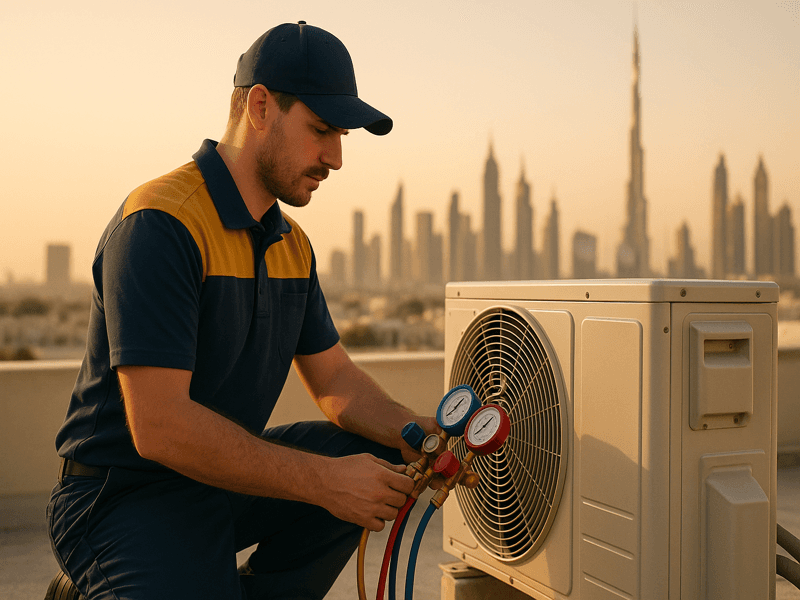
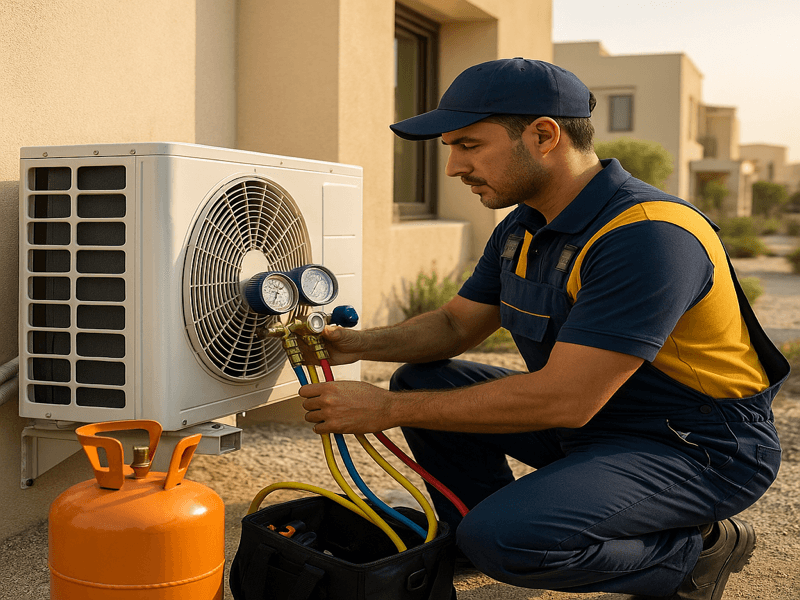
Choose a contractor whose engineers are trained across the major brands sold in the UAE, including Daikin, LG, Carrier, Trane, Mitsubishi, Samsung, O General, Gree, York, Panasonic, Hitachi and Toshiba, covering split, ducted and central systems. A good technician will arrive with the right coil cleaning equipment, refrigerant gauges and electrical test gear, and will walk you through what they find rather than simply vanishing after a quick filter rinse.
And when something fails at 11pm in the middle of a heatwave, you want a company that answers. We offer 24/7 emergency call-outs across Dubai; for out-of-hours emergencies, message us on WhatsApp at +971 50 195 8545 at any hour and we will confirm your call-out.
FAQ
How often should I service my AC in Dubai?
Because AC in Dubai runs for eight to ten months of the year, it needs servicing more often than in cooler climates. As a guide, clean or replace filters every three months, have the coils and a deeper service every three to six months, and a full duct service once a year. Homes near the coast, in dusty areas, or with heavy use often need servicing more often. Book a pre-summer service in April or May if possible.
How much does AC servicing cost for a Dubai apartment?
Typical professional charges in Dubai are around AED 150 per split AC unit, AED 200 per central AC unit and AED 500 per package unit. A standard service includes filter cleaning, coil cleaning, drain line flushing, a thermostat check, a gas pressure check, electrical inspection and performance testing. Most two-bedroom apartments need three or four units serviced per visit.
In a Dubai apartment, is the AC serviced by the building or by me?
In most cases the AC units serving your apartment must be serviced separately from the rest of the building, and arranging this is likely to be your responsibility. You should also ensure the ducts within your apartment are regularly cleaned. If you are unsure how your building handles AC, ask your building management or owner's representative before problems arise.
Should I service the AC unit in a room I rarely use?
Yes. All units in a property should be serviced on a regular schedule, including rarely used ones. Idle units collect dust in the coil and drain pan, which can lead to blocked drains, mould and musty odours when the unit is eventually switched on. Servicing everything on the same visit usually costs little more.
What are the signs my apartment AC needs repair rather than just cleaning?
Common warning signs include water leaking from the indoor unit, loud or unusual noises, warm air when set to cooling, and the unit switching off randomly. Weak airflow from the vent can also indicate a refrigerant problem. These issues typically point to refrigerant leaks, capacitor failures, blocked drain lines or compressor faults, and should be inspected by a technician.
Can I check whether my AC is cooling properly myself?
Yes. Hold your hand at the vent while the unit cools; you should feel clearly cold air. If you have a temperature gun, you can measure at the vent for an objective reading. If the air does not feel cold or readings suggest a problem, there may be a refrigerant or component issue, so book an inspection.